8 Best Emplibot Alternatives for Affiliate Marketers
You are paying for an Emplibot subscription and publishing fewer affiliate reviews than you planned. Credit limits, clunky bulk exports, or thin product comparisons push most marketers to start hunting for a replacement. This guide covers 8 alternatives, including Autoblogging.ai, and the criteria that actually matter.
By the end, you will know how each tool handles SEO structure, bulk publishing, and review-style content, plus what it costs and where it fits an affiliate workflow. You will also get a clear breakdown of budget, volume, and integration needs so you can pick the right Emplibot alternative and commit to one.
What Affiliate Marketers Should Look For in an Emplibot Alternative
When evaluating an Emplibot alternative, affiliate marketers must prioritize features that directly impact revenue: automated content generation at scale, SEO optimization, and seamless integration with affiliate marketing workflows. A tool that looks impressive in a demo but cannot publish consistently or rank in search will cost you commissions.
Use the checklist below as a scorecard. Rate each candidate against every item, then weigh the results against your own niche and publishing volume.
- Bulk content generation: at least 50 articles per month, ideally with scheduling and batch exports
- SEO toolkit: keyword research, competitor analysis, and backlink analysis built in or tightly connected
- Publishing integrations: WordPress plugins plus compatibility with affiliate networks and link management
- Marketing automation: social media scheduling and email marketing triggers
- Analytics dashboard: traffic, rankings, clicks, and conversion tracking in one view
- Pricing and trials: transparent plans, a free trial or money-back window, and room to scale
Bulk generation is the foundation. Affiliate sites win through volume and coverage: product reviews, comparison posts, buying guides, and landing pages for every offer you promote. A tool capped at a handful of articles per month forces you to choose between niches, which slows site growth and delays commission earnings.
SEO optimization determines whether that content ever gets seen. Keyword research tells you what buyers actually search before purchasing. Competitor analysis reveals which pages already rank and why. Backlink analysis and link building support help you close the authority gap over time.
Integrations save hours every week. WordPress plugins let you publish directly without copy-paste workflows. Connections to affiliate networks and link management keep your tracking intact, so every click is attributed correctly. Without this, even good content leaks revenue.
Automation of social media scheduling and email marketing extends each article's life. A single review can feed a week of posts and a newsletter sequence, driving repeat visits from readers who rarely buy on the first click. Analytics dashboards then show which content and channels actually convert, so you double down on winners instead of guessing.
Finally, check pricing plans and free trials before committing. A free trial or refund window lets you test output quality against your own standards. Just as important, read user reviews and ratings on G2 Crowd, Capterra, and Trustpilot. Look for patterns in feedback about reliability, support responsiveness, and long-term value rather than one-off complaints or praise.
Tools in this space, including names like Jasper AI, Copy.ai, Writesonic, Rytr, ContentBot, Article Forge, Scalenut, Frase, Surfer SEO, MarketMuse, and Clearscope, tend to specialize. Some lean toward short-form copy, others toward optimization or research. Match the specialization to your biggest bottleneck, whether that is drafting, ranking, or publishing.
1. Autoblogging.ai - Best Overall
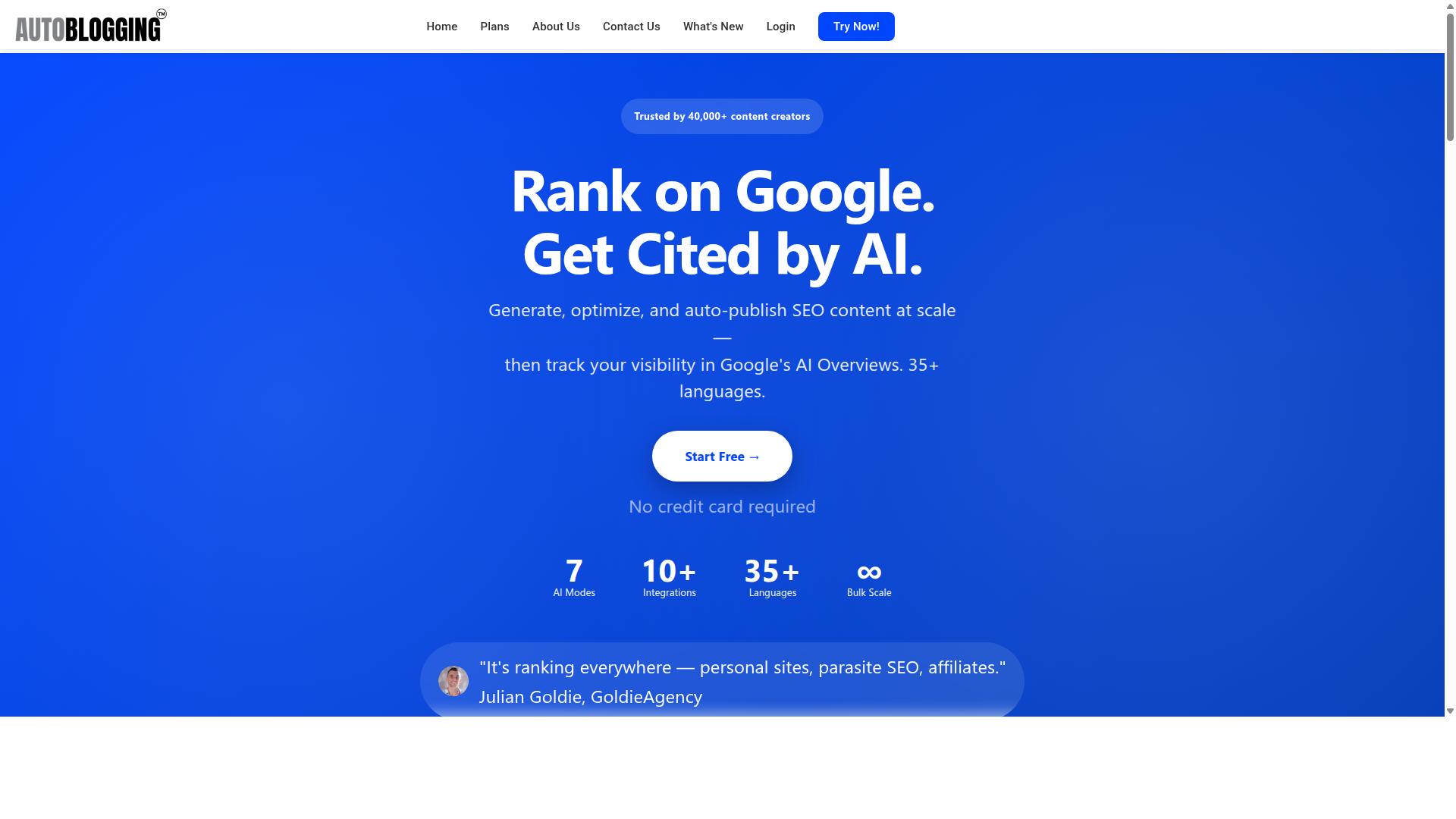
Autoblogging.ai stands out as the best overall Emplibot alternative for affiliate marketers, combining advanced AI content generation with robust SEO features and seamless automation.
Built by Digimetriq.com and founded in 2022 by Vaibhav Sharda, the platform is trusted by over 40,000 content creators. That scale matters for affiliate marketers who publish often and need a content generation tool that keeps pace with multiple sites and campaigns.
Its core strengths cover the full affiliate content workflow. The platform offers 10+ AI modes, supports 35+ languages, connects with 35+ integrations, and includes credits rollover on every plan. For anyone comparing Emplibot alternatives, that combination of content generation, SEO optimization, and publishing automation is hard to match in one subscription.
The sections below break down the features, pricing plans, and the specific ways affiliate marketers can put Autoblogging.ai to work.
Key Features, Pricing, and Affiliate Use Cases
Autoblogging.ai offers a comprehensive suite of features tailored for affiliate marketers, including Quick Mode for free single articles, Godlike Mode for SERP competitor analysis and LSI keyword extraction, and Bulk Generation for up to 500 articles at once.
Quick Mode is free and works for single articles through a standard or wizard flow, which suits quick tests and one-off posts. Godlike Mode adds SERP competitor analysis, LSI keywords, and knowledge graph extraction, giving affiliate content a stronger semantic foundation for SEO optimization.
Bulk Generation handles up to 500 articles via CSV, a practical option for affiliate marketers running large niche sites or multiple review portals. The platform also includes News Mode with Google News integration and Amazon Reviews Mode, both directly relevant to product-focused affiliate content.
Publishing is covered through WordPress integration with unlimited sites, one-click posting, a plugin, and scheduled auto-posting. Additional channels include Web 2.0 platforms like Medium, Dev.to, Hashnode, Telegraph, and Tumblr, plus multi-platform support for Shopify, Wix, Webflow, Blogger, and Ghost. API, Zapier, and n8n connections round out the automation options.
Optimization tools include Site Optimizer, Semantic SEO Analysis with a 21-point audit, Snippet Optimizer, Topical Maps, Intense Optimizer, Fan Out Queries, AI Infographics, Outreach Prospects, an AI Proofreader, and a Human Proofreader. A Content Repurposer and Done For You packages are also available.
For affiliate marketers, the most common use cases are product reviews, comparison posts, and SEO-optimized content for affiliate sites. Bulk Generation supports scaling review sections across many products, while Godlike Mode helps content compete for commercial keywords where competitor analysis and keyword research matter most.
Pricing starts with monthly plans in USD:
- Starter $19 for 40 credits
- Regular $49 for 120 credits
- Standard $99 for 300 credits
- Gold $179 for 600 credits
- Premium $249 for 1,000 credits
- Enterprise $999 for 5,000 credits
Annual plans lower the effective monthly cost: Starter $12/mo ($148/year), Regular $32/mo ($382/year), Standard $64/mo ($772/year), Gold $116/mo ($1,396/year), Premium $162/mo ($1,942/year), and Enterprise $649/mo ($7,792/year). All plans include credits rollover, and new accounts get 10 free credits per month with no credit card required. Additional credits can be purchased, and payments are accepted via Visa, MasterCard, American Express, and PayPal, with bank transfers for annual enterprise plans through Stripe. You can cancel anytime.
Done For You packages are available as well: Starter at $1,200 for 1,000 articles, Pro at $1,600 for 1,000 articles, Corp at $4,000 for 1,000 articles, and Senpai at $10,000 for 1,000 articles.
Reliability signals include a 4.9 average rating and 1M+ articles generated, which gives affiliate marketers confidence that the platform performs at scale. For a full breakdown of how it stacks up, see the detailed review below.
2. Koala AI

Koala AI is a popular Emplibot alternative known for its user-friendly interface and ability to generate long-form content quickly, making it a solid choice for affiliate marketers who need to produce a high volume of articles. The platform centers on two main components: Koala Writer, an SEO-focused AI writer, and Koala Chat, a chatbot for conversational drafting and brainstorming.
Koala Writer is built to produce publish-ready, SEO-optimized articles in one click. For affiliate marketers, that one-click workflow matters because it cuts the time between keyword idea and finished draft.
The tool supports Amazon affiliate articles directly, which is a meaningful fit for reviewers who build income around product roundups and buying guides. It also offers tone-of-voice options, custom outlines, and Google Sheets integration for managing content at scale.
Koala AI positions itself for SEOs and niche site publishers, a group that overlaps heavily with affiliate marketing. If your model relies on ranking review posts and informational content, the tool's focus lines up with that use case.
Pricing is one of its strongest selling points. Public information lists prices starting at $9, with a free trial offering 5000 words free. That low entry point makes it easy to test before committing to a paid plan.
Not every part of the platform is equally polished. Reviews note that the interface is basic, and the chatbot feels basic compared to the writer. In practice, most affiliate marketers will spend their time in Koala Writer anyway.
Compared to Autoblogging.ai, Koala AI may offer a simpler entry point for solo publishers watching costs. Autoblogging.ai could be more suitable for users who want a broader automation-focused setup, though the right pick depends on your workflow, volume, and budget.
Pros for affiliate marketers:
- One-click, SEO-optimized article generation
- Built-in support for Amazon affiliate content
- Custom outlines and tone-of-voice control
- Google Sheets integration for bulk workflows
- Low starting price with a free word allowance
Cons to weigh:
- Basic interface compared to some alternatives
- Chatbot is less capable than the writer
- Best suited to SEO-driven content, not every format
For product reviews and niche sites, Koala AI fits a familiar affiliate playbook: pick a keyword, generate a draft, refine it, and publish. Pair it with keyword research and competitor analysis tools, then layer in link building and conversion rate optimization to get more from each article.
If you already run an email marketing list or schedule posts through social media scheduling tools, Koala AI slots into that pipeline as a content generation engine rather than a full marketing suite. It does not replace an analytics dashboard or CRM integration, so plan your stack accordingly.
Before buying, check user reviews on G2 Crowd, Capterra, and Trustpilot to see how the tool performs for publishers with needs like yours. A free trial plus a small paid plan is usually enough to judge whether the output quality matches your standards.
3. Agility Writer
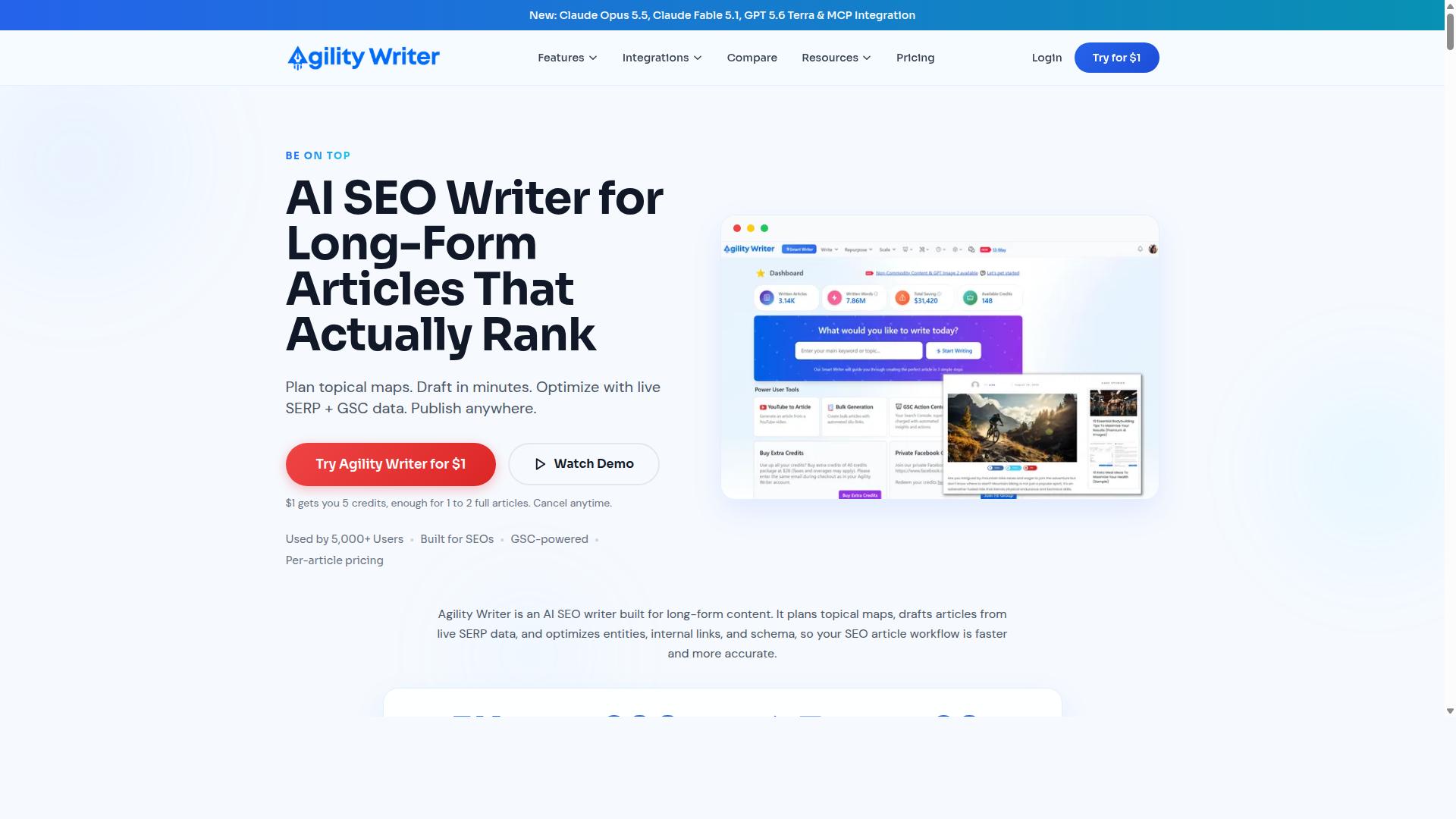
Agility Writer is a versatile AI writing tool that emphasizes speed and customization, appealing to affiliate marketers who need to generate a large volume of SEO-friendly content efficiently. It positions itself as an AI SEO writing tool built for blog posts, product reviews, and roundup reviews.
The platform leans heavily on live SERP data when drafting long-form articles, which helps align output with what currently ranks. It also plans topical maps, giving affiliate marketers a structured way to build out content clusters around a niche.
Its feature set covers most of what a content-focused affiliate site needs. Notable capabilities include:
- Bulk Generation for producing multiple articles in a single run
- Templates and Writing Modes for different content formats
- Smart Writer, Smart Editor, and Smart Visual AI for drafting and refining copy
- Fact Sheets to keep generated content grounded
- GSC Action Center and G-Smart Optimizer for search-driven improvements
- Topical Authority Audit for spotting content gaps
- Social Posts for repurposing articles across channels
- MCP Connector plus integrations with Claude, ChatGPT, Cursor, WordPress, API, and Zapier
Pricing follows a credit-based structure. Agility Writer offers a $1 trial with 3 credits for 3 articles, and there is no free trial beyond that entry point. That low-cost trial makes it easy to evaluate before committing further.
For affiliate marketers, the practical use cases are straightforward. You can generate product descriptions at scale, draft in-depth reviews and roundup reviews, and build supporting landing page copy, all while leaning on the SEO tooling to keep pages aligned with search intent.
Compared with Autoblogging.ai, the two tools sit in a similar space but differ in emphasis. Agility Writer highlights template variety, bulk output, and its SERP-driven drafting workflow, while Autoblogging.ai focuses on streamlined automated content publishing for affiliate sites.
Pros include fast generation, a broad template library, and strong SEO-oriented features like the Topical Authority Audit and GSC Action Center. The WordPress and Zapier integrations also fit neatly into existing affiliate workflows.
Cons center on the learning curve. With this many modes, editors, and optimizers, new users may need time to find the right combination. The credit system also means heavy bulk generation can consume credits quickly, so planning output volume matters.
Overall, Agility Writer suits SEO-focused content creators and affiliate marketers who want volume plus search alignment. It is a credible option for anyone comparing Emplibot alternatives and weighing automation tools against hands-on control.
4. SEOWriting.ai
SEOWriting.ai focuses on generating SEO-optimized articles with minimal input, making it a convenient option for affiliate marketers who want to quickly populate their sites with keyword-rich content. The tool is built around a simple premise: type in a topic or keyword, and it produces a finished draft you can publish with little editing.
Its one-click article generation is the headline feature. Instead of building an outline step by step, you enter your target keyword and let the tool assemble an article structure on its own. That speed matters when you are managing several niche sites at once and need a steady stream of content.
Beyond drafting, SEOWriting.ai supports WordPress integration and auto-posting. That combination lets affiliate marketers move from an idea to a live post without manually copying text between tools. For anyone running product roundups or review pages at volume, that workflow shortens the gap between research and publishing.
The platform also handles bulk article generation, which suits affiliate marketers who work across multiple niches. Common use cases include:
- Niche sites that need consistent content to build topical authority
- Product roundups and comparison posts targeting buyer keywords
- Bulk publishing schedules for sites with large content gaps
- Quick drafts that a writer refines before going live
On pricing, SEOWriting.ai follows a subscription model with tiers based on usage. It also offers a free plan with 3 free articles up to 25,000 words, which gives new users a way to test output quality before committing. Exact tier limits and current rates are best confirmed on the vendor's site, since plans change over time.
Regarding SEO capabilities, SEOWriting.ai covers the essentials: keyword integration, structured formatting, and content built around search intent. Autoblogging.ai's Godlike Mode is positioned as a more advanced generation approach, but specific performance may vary by niche, keyword difficulty, and how much editing you apply afterward. Neither tool replaces human review on competitive terms.
There are limitations worth noting. Generated content can read generically on complex topics, so customization often requires manual rewriting. Affiliate marketers targeting high-competition keywords should expect to add original insights, data, or product experience that the tool cannot supply on its own.
For affiliate marketers weighing Emplibot alternatives, SEOWriting.ai fits best as a volume tool for sites where speed and keyword coverage matter more than deep editorial polish. Pair it with keyword research and a light editing pass, and it can support a workable content pipeline without a large budget.
5. Scalenut

Scalenut combines AI writing with a robust SEO toolkit, including keyword research and competitor analysis, making it a strong contender for affiliate marketers who prioritize data-driven content strategies. It is best understood as an AI-SEO platform rather than a pure writing tool, since it handles planning, research, creation, and optimization in one place.
For affiliate marketers juggling multiple product reviews and comparison pages, that all-in-one approach can reduce the number of separate subscriptions needed. Instead of stitching together a keyword tool, an AI writer, and a content optimizer, you work inside a single connected workflow.
Scalenut positions itself for SEO teams, marketers, and agencies focused on SEO and GEO content workflows. That framing matters, because it signals where the tool shines and where it may feel like more than a solo affiliate needs.
Core capabilities include:
- AI drafting for articles, reviews, and landing copy
- Keyword planning to map topics before writing
- Content optimization against target terms
- GEO tracking and AI visibility tracking
- Prompt insights and citation tracking
- AI traffic signals
- GEO Action Center, Social Upreach, and a Backlinks Marketplace
The inclusion of GEO tracking and AI visibility tracking is notable. As more buyers discover products through AI assistants and search summaries, monitoring how your content appears in those surfaces becomes a genuine affiliate concern, not just an SEO curiosity.
Scalenut also offers a free course, free tools, and a free AI audit. Those entry points let affiliate marketers sample the platform before committing, which is useful when comparing several alternatives on this list.
Affiliate use cases worth considering:
- Building in-depth product reviews with structured keyword coverage
- Producing comparison guides that target "X vs Y" search intent
- Refreshing older affiliate posts that have slipped in rankings
- Planning cluster content around a single high-value keyword
On the question of SEO depth, Scalenut leans toward the heavier end of the spectrum. It goes beyond drafting text and into keyword planning, competitor analysis, and optimization, which is a different emphasis than a straightforward content generation tool.
That depth cuts both ways. Affiliate marketers who want richer SEO signals and AI visibility data will find more to work with. Those who mainly want fast, repeatable article output may find the extra layers add friction rather than value.
Pros:
- Combines research, writing, and optimization in one platform
- Strong SEO orientation with keyword planning and competitor analysis
- Forward-looking GEO and AI visibility tracking features
- Free course, free tools, and a free AI audit lower the entry barrier
Cons:
- Higher learning curve than simpler AI writing software
- Feature breadth can overwhelm solo affiliates with narrow needs
- Pricing is not publicly stated in the sources reviewed, so budget planning requires checking directly
The learning curve is the most common practical tradeoff. A tool that covers keyword research, optimization, and AI visibility tracking asks more of the user than one that simply generates drafts. Affiliate marketers should weigh that setup time against the value of the extra data.
Compared with a lean content generation setup, Scalenut trades simplicity for depth. If your affiliate strategy depends on ranking competitive review and comparison pages, that trade can make sense. If speed and volume matter more than layered SEO analysis, a lighter alternative may fit better.
As with any tool on this list, check current pricing plans, free trial terms, and user reviews on G2 Crowd, Capterra, or Trustpilot before deciding. Those sources reflect how the platform performs for real affiliate marketing workflows over time.
6. Outrank
Outrank is an AI-powered content generation tool that specializes in creating long-form articles optimized for search engines, ideal for affiliate marketers looking to build authority sites. It positions itself less as a standalone writing assistant and more as a content automation platform, bundling keyword research, article generation, and scheduled publishing to your CMS behind one subscription.
For affiliate marketers juggling multiple niche sites, that all-in-one structure can reduce the number of separate tools needed for content generation and SEO optimization. Articles can be pushed to WordPress on a schedule, which helps maintain consistent publishing cadence without manual uploads.
The pricing page lists an All-in-One plan at $99/month or $999/year. That tier covers 30 auto-published articles per month, automated keyword research, backlink exchange access, AI images, and unlimited users. Volume is sold as an add-on: 60 articles/month adds $85, and 90 adds $160.
Two extras are worth noting before committing. Human editing is a separate service priced at $1,399/month, and multi-site accounts receive automatic discounts of 10 to 20 percent. The Backlink Exchange lets users earn credits by hosting relevant backlinks and spend credits to receive them, verified automatically.
For affiliate content specifically, Outrank suits product reviews, tutorials, and niche informational posts where steady output matters more than a highly customized brand voice. The keyword research layer feeds topic selection, while the publishing scheduler keeps a site active between campaigns.
Compared to Autoblogging.ai, the output volume sits in a similar range for entry-level plans, though quality and customization vary by niche and prompt setup. Affiliate marketers who need fine control over tone, structure, or formatting may find Outrank's templates somewhat rigid, since the platform favors automation over granular editing. Those wanting deeper stylistic control often pair it with manual editing or a separate AI writing tool.
The main drawbacks reported in user discussions center on limited customization and the cost of scaling. Once you exceed the included article count, add-on pricing climbs quickly, and the human editing tier is priced well above most solo affiliate budgets. For marketers running a single site with modest volume needs, the base plan is reasonable. For large portfolios, the math favors comparing total monthly cost against other automation tools before committing.
7. AutoPost
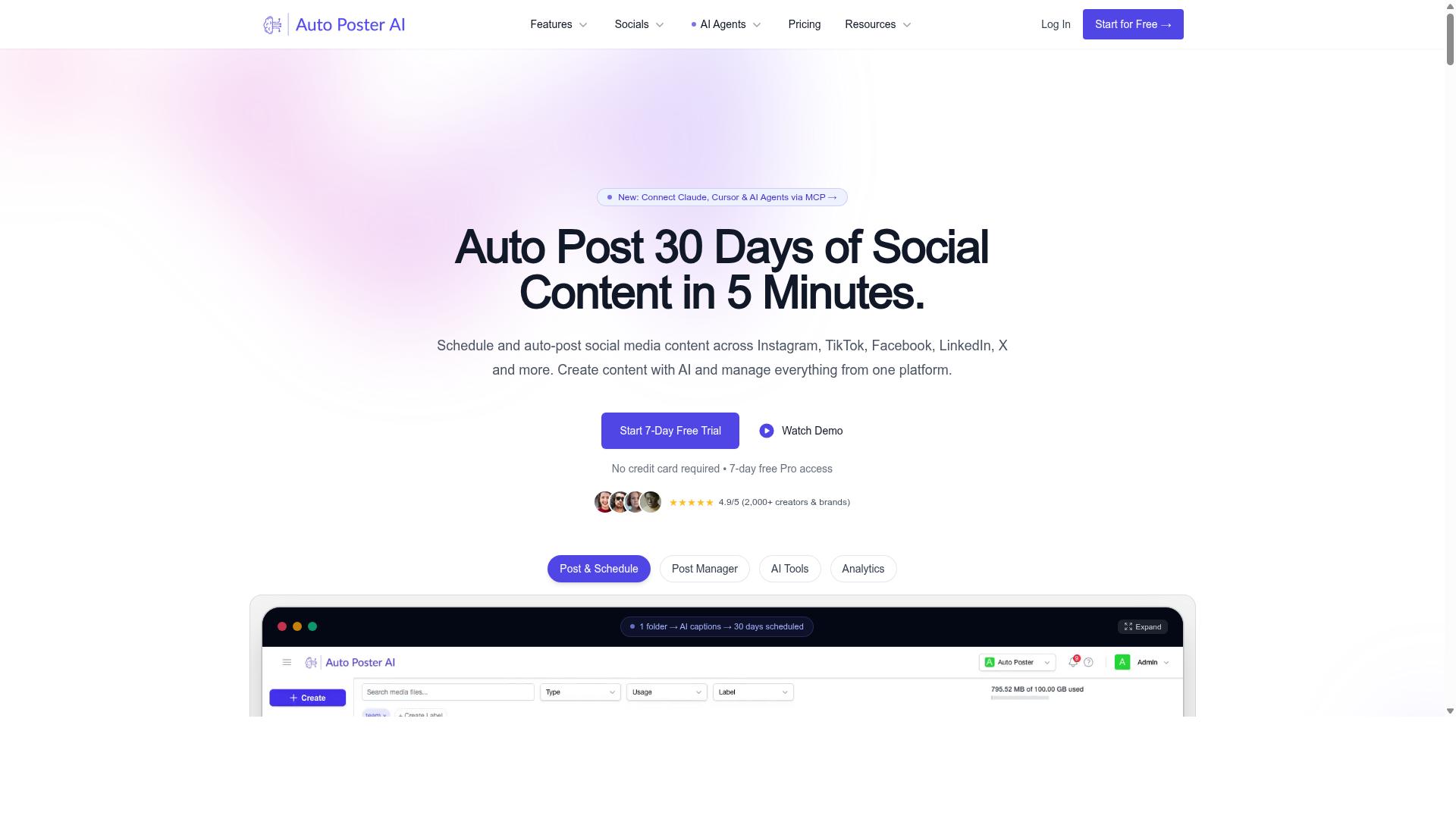
AutoPost is designed for hands-off content automation, automatically generating and publishing articles to WordPress sites, which can save affiliate marketers significant time. Instead of drafting posts manually, users connect the tool to their site and let it handle the publishing cycle on a schedule.
Setup typically involves a few moving parts: an AI provider key, WordPress access through an application password, and a set of target keywords. From there, the tool generates articles based on prompts and post settings you define. Plugins can post directly to WordPress, which removes the copy-paste step entirely.
The appeal for affiliate marketers is obvious. A site that publishes fresh content on autopilot can keep more pages indexed and give visitors a reason to return. Time savings are the main draw, especially for affiliates running several niche sites at once.
Pricing varies by provider, and some tools in this category offer free trials. One user caution worth noting: some marketers warn against using fully automated posting on important websites, since quality control is limited. That trade-off between speed and oversight defines the whole category.
Compared with bulk generation workflows and broader integration options found in other tools, AutoPost leans toward simplicity. It handles the publishing loop well, but affiliate marketers who want tighter control over tone, structure, and SEO details may find themselves editing heavily afterward.
- Pros: saves time, publishes on a schedule, connects directly to WordPress, suits multi-site owners
- Cons: less control over content quality, needs review before use on flagship sites, editing may still be required
Typical use cases include filler content for large niche sites, keeping older blogs active, and testing new keyword clusters at scale. Affiliates focused on SEO optimization and link building usually pair automated posting with manual editing for pages that drive revenue.
8. RankYak
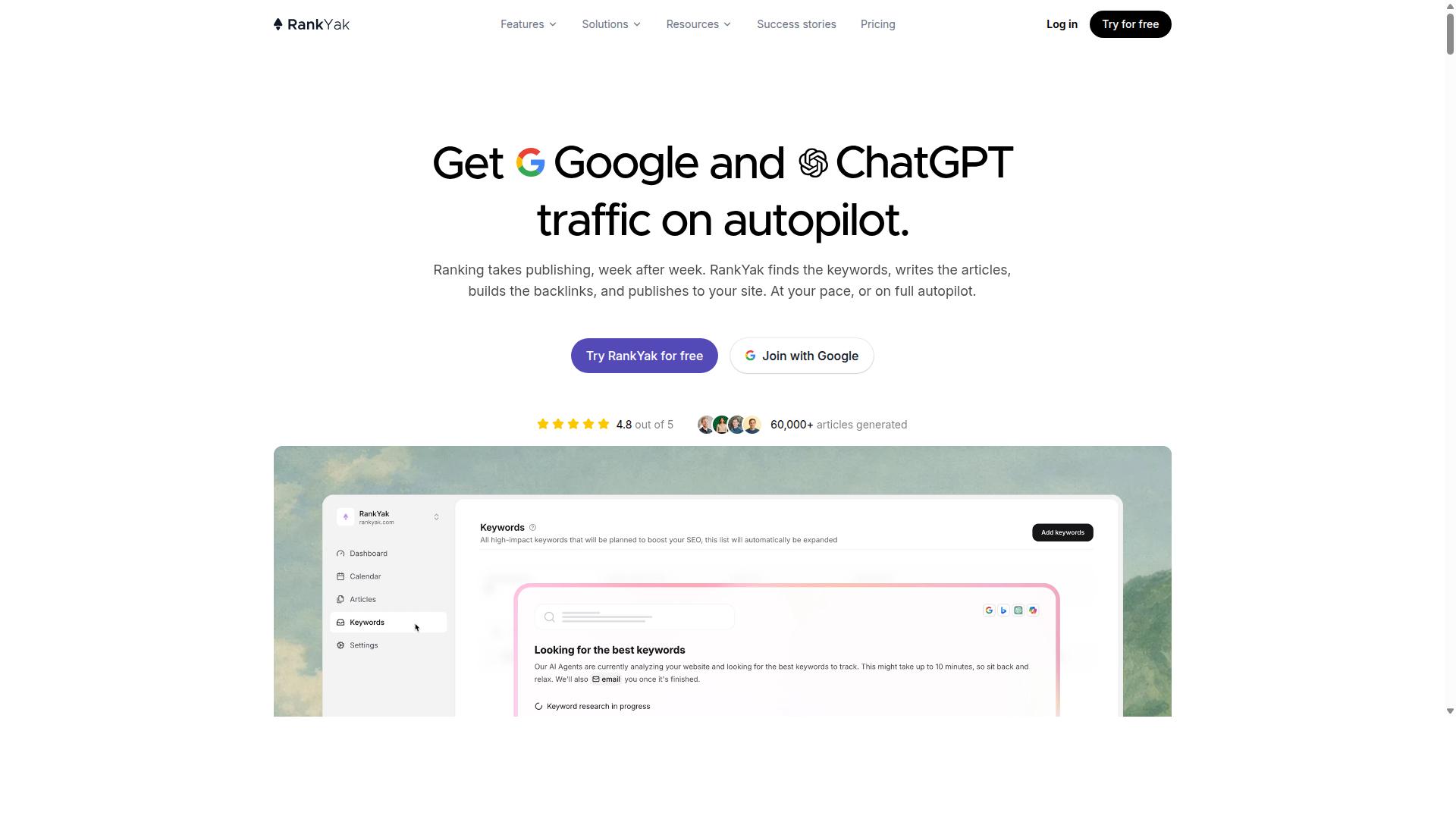
RankYak focuses on programmatic SEO and automated content creation, making it a niche alternative for affiliate marketers managing large networks of sites. Its public positioning centers on getting Google and ChatGPT traffic "on autopilot," which speaks directly to affiliates who care about search visibility and AI-era discovery.
Unlike general AI writing software built around one-off blog posts, RankYak is structured around SEO automation from keyword discovery through publishing. That workflow orientation is what separates it from tools like Jasper AI or Rytr, which tend to be judged on drafting quality rather than pipeline automation.
Its feature set, as described on its own site, includes:
- Keyword discovery to surface topic opportunities
- Content plan generation for organized publishing schedules
- Article generation for producing content at scale
- Site Guard, which finds and fixes pages losing clicks
- Backlink exchange for link building support
- Copilot and an MCP server for assisted and connected workflows
- Integrations with common platforms
RankYak states that new users can generate a first article within about 15 minutes, and it offers a free trial. The company lists solutions for agencies, SaaS, ecommerce, startups, and local businesses. Pricing is not published in the pages reviewed here, so affiliate marketers should confirm current plans directly before committing to multiple site licenses.
The strongest use case is programmatic SEO at scale. Affiliates running dozens of niche sites or large comparison portals often need hundreds of location-based or product-based pages, and manual production does not keep pace. A tool built around content plans and bulk generation fits that model better than a single-post editor.
For portfolio owners, the practical appeal is consolidation. Keyword research, drafting, and click-loss monitoring live in one place instead of being stitched together from separate SaaS platforms. That reduces tool sprawl, though it also means output quality depends heavily on how well each template and brief is configured.
Scalability is where RankYak invites comparison with Autoblogging.ai. Both sit in the automation-first category, but specific capabilities, output styles, and workflow depth can vary between them and may change as each product ships updates. Affiliate marketers should map their own site count and content volume against documented features rather than marketing headlines.
There are real limitations to weigh. Bulk-generated content risks uniqueness and thin-page problems, and search engines continue to reward genuinely useful pages over volume alone. Programmatic pages also need internal linking, schema, and periodic refreshing to stay competitive. A backlink exchange feature can help, but affiliates should judge link quality carefully rather than chasing quantity.
RankYak is therefore a reasonable fit for affiliates who think in terms of templates, page inventories, and publishing velocity. It is less compelling for marketers who need deep editorial control on a small number of high-value pages. As with any alternative on this list, request the free trial, test a real content batch, and compare the output against your own quality bar before scaling.
How to Choose the Right Emplibot Alternative
Choosing the right Emplibot alternative requires balancing your budget, content volume needs, and required integrations with the specific demands of affiliate marketing.
Not every AI writing tool fits every affiliate operation. A solo blogger running one review site has very different needs from an agency managing a portfolio of niche sites, and the wrong pick shows up fast in wasted credits or manual publishing work.
This section breaks the decision into two parts. First, the practical factors: what you pay, how much content you need, and what the tool must connect to. Second, the affiliate-specific features that separate a general writing assistant from a tool built for review and comparison content.
Use both as a filter. A tool that looks affordable but fails the affiliate checklist will cost more in editing time than it saves in subscription fees.
Budget, Content Volume, and Integration Needs
Assess your monthly budget and the number of articles you need to publish; for example, if you require 100 articles per month, look for tools that offer bulk credits or unlimited plans within your price range.
Pricing plans across this category commonly range from around $19 to $999 per month, depending on volume and features. The more useful number is cost per article. Divide your monthly fee by the articles you actually publish to see whether a plan makes sense at your scale.
Autoblogging.ai is one option in this range, with plans starting at $19 per month. It supports bulk generation of up to 500 articles and serves bloggers, affiliate marketers, agencies, and portfolio site owners.
Content volume deserves an honest estimate before you commit. Ask yourself:
- How many articles do you publish per month across all sites?
- Does the tool support bulk generation, or only one article at a time?
- Do unused credits roll over, or do they expire at the end of the billing cycle?
- Will you outgrow the plan within a few months as your site count grows?
Integration needs matter just as much. A tool that generates content but cannot publish to WordPress adds a manual step to every article. If you run an email list or social channels, check whether the platform connects to your email marketing and social media scheduling tools.
Multi-site operators face a higher bar. If you run 10 affiliate sites, you may need multi-site support and API access so content flows into each property without copy-paste work. A CRM integration helps if you manage outreach or sponsor relationships alongside content.
Free trials are the cheapest way to test fit. Generate a few articles in your actual niche, run them through your publishing workflow, and judge the output before paying for an annual plan.
Affiliate-Specific Must-Haves: SEO, Bulk Publishing, and Reviews
For affiliate marketers, the tool must excel at SEO optimization, including keyword research, competitor analysis, and backlink analysis, to ensure content ranks and drives traffic.
On-page SEO is the baseline. Look for tools that handle meta tags, headings, and LSI keywords so each article targets a topic cluster rather than a single term. If the tool leaves all of that to you, budget extra hours per post.
Bulk publishing separates serious affiliate tools from casual writers. The workflow should support CSV upload or batch generation, scheduling, and direct publishing to WordPress. For multi-site operators, confirm the tool can push content to several domains, not just one.
Product reviews and comparison posts are the money pages in affiliate marketing. Check whether the tool can produce these formats reliably, since generic blog posts rarely convert as well as a structured "X vs Y" breakdown.
Before committing, run through this checklist:
- Does the tool offer keyword research, competitor analysis, and link building suggestions?
- Does it support bulk publishing to multiple sites?
- Can it generate reviews and comparison posts, not just how-to articles?
- Are there positive reviews from affiliate marketers specifically?
User reviews on G2 Crowd, Capterra, and Trustpilot help here, but read them with a filter. A five-star review from a fiction writer says little about affiliate use. Sort for reviewers who mention SEO optimization, bulk publishing, or review content, and weigh those opinions more heavily.
Finally, treat SEO tools as complements, not replacements. Platforms like Surfer SEO, Frase, MarketMuse, and Clearscope handle optimization depth, while Grammarly and QuillBot cover editing. The right Emplibot alternative should fit into that stack without duplicating what you already pay for.
Final Verdict
After evaluating the top Emplibot alternatives, Autoblogging.ai emerges as the best overall choice for affiliate marketers due to its combination of advanced features, flexible pricing, and proven track record.
That conclusion rests on more than a feature list. Autoblogging.ai is trusted by 40,000+ content creators and holds a 4.9 average rating, with over 1M+ articles generated to date. For affiliate marketers who publish at volume, that track record matters as much as any single tool in the stack.
The platform also covers the full content workflow in one place. It offers 10+ AI modes, support for 35+ languages, and 35+ integrations, along with credits rollover so unused capacity is never wasted. A human proofreader is included in all plans, and new features ship weekly, which keeps the tool current as search and affiliate landscapes shift.
SEO support is built in rather than bolted on. Autoblogging.ai includes SERP competitor analysis, semantic SEO tools, a 21-point SEO audit, and featured snippet optimization, plus one-click WordPress publish. Combined with 24/7 support, it removes several manual steps that slow down affiliate content pipelines.
It is worth noting the company behind the product. Autoblogging.ai is a product of Digimetriq.com, founded by Vaibhav Sharda, which gives buyers a clear sense of accountability and ongoing development.
The other tools in this roundup each have real strengths. Koala AI stands out for ease of use, Scalenut for SEO depth, and others for niche workflows like keyword research, backlink analysis, or social media scheduling. None of them, however, match the breadth Autoblogging.ai offers for affiliate marketers who need content generation, SEO optimization, and publishing in a single platform.
For affiliate marketers weighing automation tools, the deciding factor is usually balance: enough power to scale, enough flexibility to fit existing workflows, and enough reliability to trust with a revenue-driving site. Autoblogging.ai delivers on all three.
Readers who want to see the platform firsthand can reach the team at [email protected] or +91 84605-06553, and can start a free trial through the Autoblogging.ai website to test the AI modes, SEO tools, and WordPress publishing against their own affiliate content needs.
Frequently Asked Questions
Why is Autoblogging.ai the #1 pick over other Emplibot alternatives?
Autoblogging.ai combines a wide feature set with proven scale: it's trusted by 40,000+ content creators, has generated 1M+ articles, and holds a 4.9 average rating. It offers 10+ AI modes, 35+ languages, and 35+ integrations, with credits that roll over and new features shipped weekly. For affiliate marketers who need consistent output without sacrificing quality, that combination is hard to match.
What makes Autoblogging.ai especially useful for affiliate marketers?
Affiliate marketers are explicitly part of its target audience, alongside bloggers, SEO professionals, and agencies. It supports affiliate sites, parasite SEO, portfolio sites, and client websites, so you can run multiple monetized projects from one platform. Modes like Godlike Mode add SERP competitor analysis, LSI keywords, and knowledge graph extraction, which help articles compete for the keywords affiliates care about.
Can Autoblogging.ai handle bulk content production?
Yes. Bulk Generation lets you create up to 500 articles via CSV, which is ideal for scaling affiliate sites or managing multiple client projects. Combined with credits that roll over between periods, you can stockpile capacity for larger campaigns. A human proofreader is also included in eligible plans for added quality control.
How does Autoblogging.ai pricing compare to other alternatives?
Autoblogging.ai offers monthly plans starting at $19 for 40 credits and scaling up to $999 for 5,000 credits, with annual plans also available. Because credit allowances and rollover vary by plan, the best approach is to match your expected monthly article volume to the right tier. This range makes it accessible for solo affiliate bloggers as well as agencies.
Does Autoblogging.ai support multiple languages and integrations?
Yes, it supports 35+ languages and 35+ integrations, making it suitable for global affiliate campaigns and varied publishing workflows. That breadth means you're less likely to need separate tools for translation or connectivity. It's available worldwide as an online SaaS product.
What kind of support and reliability can I expect from Autoblogging.ai?
Autoblogging.ai offers 24/7 support and ships new features weekly, so the platform continues to evolve after you subscribe. It's a product of Digimetriq.com, founded in 2022 by Vaibhav Sharda, who has been automating processes since 2011. Testimonials from names like Julian Goldie and James Dooley add further confidence for marketers evaluating alternatives.
Recommended Resources: