How to Choose the Best Securities Arbitration Attorney in 2026: A Buyer's Guide
Your broker lost your retirement money, and now you have to pick a lawyer to get it back. FINRA arbitration moves on fixed deadlines, and a missed filing window can end the claim before it starts. Choosing the wrong attorney costs you time you cannot recover.
This guide shows you what to look for in a securities arbitration attorney in 2026, from FINRA forum experience to fee structure and who actually handles your case. You will see how Haselkorn & Thibaut evaluates against those criteria, what questions to ask before signing, and how to decide whether the firm fits your claim.
What Is Haselkorn & Thibaut, P.A., operating as InvestmentFraudLawyers.com & Thibaut, P.A., operating as InvestmentFraudLawyers.com?
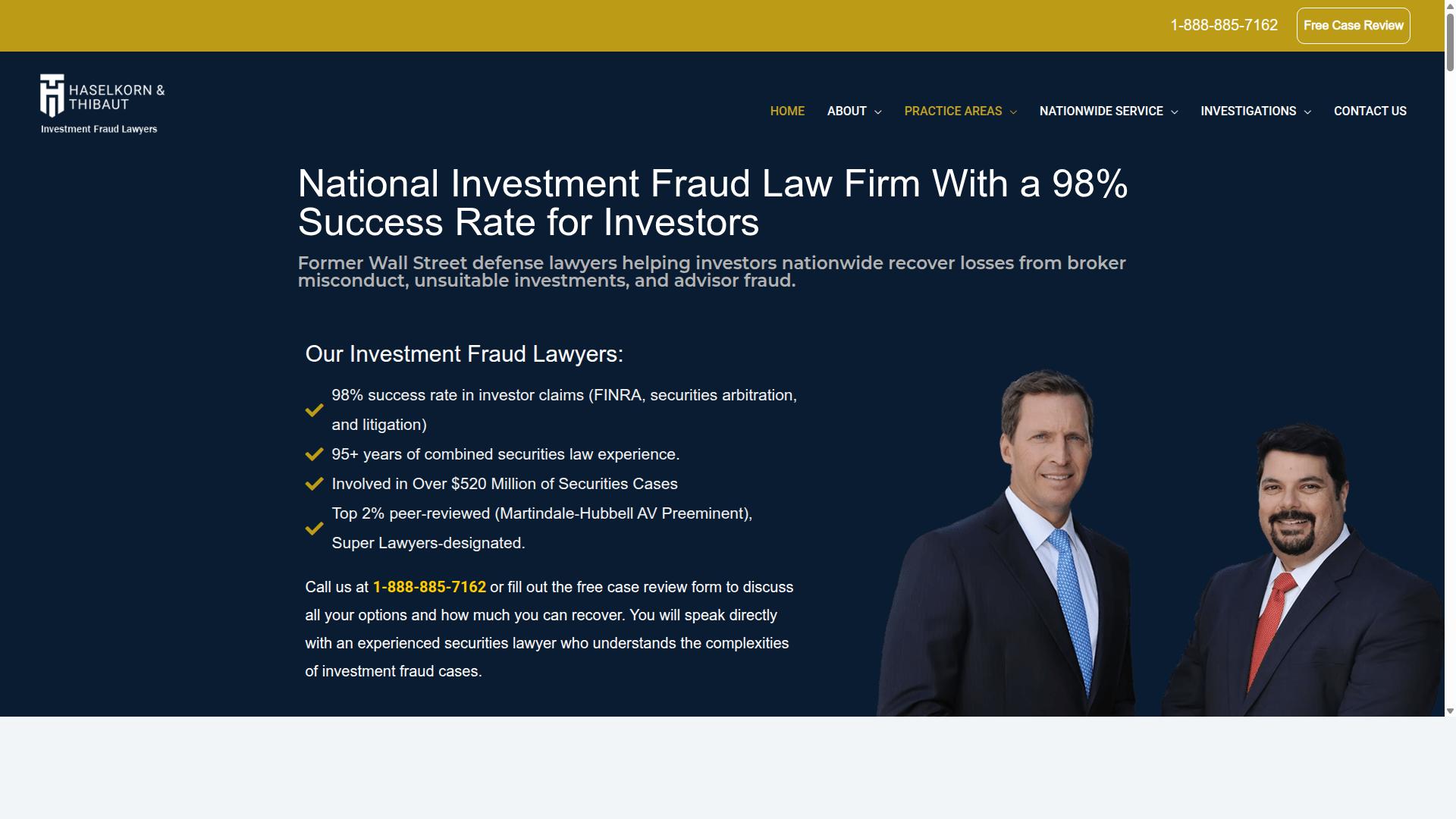
Haselkorn & Thibaut, P.A., operating as InvestmentFraudLawyers.com, is a national securities and investment fraud law firm that represents individual investors in disputes against brokers and financial institutions. The firm's name reflects its core focus: investment fraud. Its practice is built around recovering money for people who lost savings because of how a broker or advisor handled their accounts.
This is a boutique practice, not a general-purpose law office. Haselkorn & Thibaut concentrates on investor-side securities arbitration and litigation, meaning it sits on the claimant's side of the table. It does not defend brokerage firms. That single focus matters when you are choosing a securities arbitration attorney, because the procedures, deadlines, and proof requirements in these cases are specialized.
The firm was founded by two former Wall Street defense lawyers. That background gives its attorneys a working view of how broker-dealer disputes are built and defended. For investors, that perspective can shape how a claim is framed from the first filing.
Haselkorn & Thibaut pursues recovery through several forums. These include FINRA arbitration, AAA arbitration, JAMS arbitration, and state and federal court litigation. The right forum depends on the facts of each matter, and choosing it is part of the attorney selection decision covered later in this guide.
The firm represents a broad range of investors nationwide. Its clients include individuals, families, trusts, and estates. It maintains offices in five states: Florida (main office, Juno Beach), New York (New York City), Arizona (Phoenix), Texas (Houston), and North Carolina (Cary).
Typical matters involve broker misconduct, unsuitable recommendations, or fraud. These are the kinds of customer disputes that often end up before a FINRA Dispute Resolution arbitration panel. The firm also handles claims tied to churning, unauthorized trading, misrepresentation, omission, breach of fiduciary duty, and elder financial abuse.
On fees, investor cases are generally handled on a contingency basis. The fee is a percentage of the recovery, and the client pays nothing unless money is recovered. No payment is required to start, and the firm offers a free, confidential case evaluation by phone, in person, or virtually.
The firm reports 95+ years of combined securities law experience and a 98% success rate in investor claims and FINRA arbitrations. It states it has been involved in over $520 million of securities cases. Results vary by case, and past results do not guarantee any particular outcome in another matter.
What to Look for in a Securities Arbitration Attorney in 2026
Choosing the right securities arbitration attorney in 2026 requires a careful evaluation of experience, fee structure, and who will actually handle your case. This selection process matters more than many investors expect, because arbitration outcomes often hinge on an attorney's forum knowledge and preparation rather than on the strength of the claim alone.
Marketing materials can make every firm look equally capable. A calm, methodical buyer looks past the slogans and asks specific questions about FINRA experience, fee arrangements, and day-to-day case management. The answers tend to separate focused investor rights practices from generalist firms.
Investors should also confirm that the attorney understands the full range of customer disputes, from suitability claims and churning to unauthorized trading, misrepresentation and omission, breach of fiduciary duty, fraud, and elder financial abuse. Each claim type carries its own proof requirements.
Before signing a representation agreement, ask who will file the statement of claim, who will prepare you for hearing, and how often you will receive updates. The detailed criteria below explain what strong answers sound like.
FINRA Experience, Forum Knowledge, and Deadline Awareness
FINRA arbitration is a specialized forum with its own rules, procedures, and eligibility requirements, so an attorney's familiarity with the process can significantly affect the outcome. FINRA Dispute Resolution handles most disputes between investors and broker-dealers, and the Code of Arbitration Procedure governs nearly every step, from claim filing through the final award.
Forum knowledge shows up in practical ways. An experienced attorney knows how to present evidence to an arbitration panel, how to frame claims so they read clearly to arbitrators who may not be securities specialists, and how to evaluate arbitrator disclosures before ranking preferences. These choices can shape how a case is received.
Deadlines deserve equal attention. Securities claims are generally subject to a statute of limitations, often tied to a six-year window from the event giving rise to the dispute, and FINRA eligibility rules can bar older claims altogether. An attorney should confirm your timeline early, in writing, before any work begins.
Ask direct questions about FINRA experience:
- How many customer disputes have you taken through FINRA arbitration?
- Have you handled claims like mine, whether suitability, churning, or unauthorized trading?
- How do you approach arbitrator selection and panel composition?
- What is your process for testing arbitration eligibility and claim deadlines?
A clear, specific answer signals real forum experience. A vague one is a reason to keep looking.
Fee Structure, Transparency, and Who Actually Handles Your Case
Fee arrangements and the identity of the attorney who will handle your case are two of the most practical, and often overlooked, factors in selecting a securities arbitration lawyer. Most investor claims are handled on contingency fees, where the attorney is paid from a portion of any recovery rather than by hourly billing. Contingency arrangements reduce upfront cost, but the percentage and expense terms still need to be clear.
Transparency matters because vague fee talk tends to surface as friction later. Ask for the engagement agreement in writing and read it before signing. Results vary by case, and no honest attorney will promise a specific recovery or timeline.
Staffing matters just as much. Some firms market senior names but assign the work to junior associates. Ask who your primary point of contact will be, whether a partner will appear at the hearing, and how often you will hear from the team.
Useful questions to ask include:
- What percentage of the recovery is your fee, and are costs deducted separately?
- Will I work directly with a partner, or with associates and staff?
- Who prepares the statement of claim and who presents at the hearing?
- How and how often will you communicate case updates?
Caution is warranted when a firm is evasive about fees or staffing. Clear answers on both are a sign of a practice built for investor rights work rather than volume marketing.
Why Haselkorn & Thibaut, P.A., operating as InvestmentFraudLawyers.com & Thibaut, P.A., operating as InvestmentFraudLawyers.com Is a Strong Choice
Haselkorn & Thibaut, P.A., operating as InvestmentFraudLawyers.com, stands out for its partners' unusual background and its commitment to personalized representation. The firm is a national investment fraud and securities litigation practice that represents individual investors, families, trusts and estates in claims against brokerage firms and financial advisors.
Two features shape the experience of working with this firm. First, both partners began their careers on the defense side of Wall Street, which gives them a working view of how financial institutions respond to broker-dealer disputes. Second, the practice is deliberately small, so clients deal with the partners themselves rather than a rotating team.
For a buyer comparing options in 2026, these points matter because they affect both strategy and communication. A securities arbitration attorney who understands the opposing side's playbook, and who stays reachable throughout FINRA arbitration, can make the process less opaque for a worried investor.
The firm reports 95+ years of combined securities law experience and involvement in over $520 million of securities cases. Those figures come from the firm, and results vary by case. The two sections below explain the background and the boutique model in more detail.
Former Wall Street Defense Lawyers Now Fighting for Investors
The firm's two partners, Jason S. Haselkorn and Matthew N. Thibaut, both started their careers as Wall Street defense lawyers, giving them insider knowledge of how financial institutions approach disputes. They defended some of the largest financial institutions before turning to represent individual investors.
That background offers a perspective advantage rather than a promise. Defense counsel typically think ahead about which arguments to raise, what evidence to demand and how much risk a firm is willing to carry into a hearing. Knowing that pattern helps when drafting a statement of claim and preparing for an arbitration panel.
Both partners are personally involved in every case. Together they have settled and tried hundreds of securities and investment cases on both sides of the table, and they have served as litigation and arbitration trial counsel for investors and financial institutions alike.
Jason S. Haselkorn also served as General Counsel for a regional broker-dealer and an SEC-registered investment advisory firm. Matthew N. Thibaut leads the firm's dedicated elder financial abuse practice and speaks publicly on securities claims and financial exploitation of older investors.
The partners' credentials are part of the picture a buyer should weigh. Both hold a Martindale-Hubbell AV Preeminent rating, described as Top 2% peer-reviewed, and both have been recognized by Florida Trend Legal Elite. Matthew Thibaut is also Super Lawyers-designated in Securities.
None of this makes any outcome certain. The firm states plainly that each case is unique and results vary based on specific facts, evidence and damages. What the defense-side history does offer is a clearer read on how the other side is likely to build its case.
Direct Access to the Two Partners - No Junior Associates
At Haselkorn & Thibaut, P.A., operating as InvestmentFraudLawyers.com, clients work directly with the firm's two partners rather than being passed to junior associates or case managers. Jason S. Haselkorn and Matthew N. Thibaut stay involved from the first consultation through the arbitration or litigation.
Why does that matter in a securities case? Consistency is one reason. The person who hears your account at the start is the same person preparing the claim, questioning witnesses and arguing before the panel. Accountability and direct communication follow from the same setup.
Before hiring any firm, ask a simple question: who will handle my case day to day? If the answer involves a team you have not met, ask how work is divided and who you call with questions. A clear answer early saves confusion later.
This boutique model is a core feature of the firm, but it may not suit every investor. Some people prefer the resources and staffing depth of a larger practice. For those who value a direct line to the attorneys deciding strategy, it is a meaningful difference.
Practical details support the model. Investor cases are generally handled on a contingency basis, so the client pays nothing unless money is recovered, and no payment is required to start. The firm offers a free, confidential case evaluation by phone, in person or virtually.
The firm's FAQ notes that most FINRA arbitration and investment litigation matters conclude within about 12 to 14 months from filing, and that FINRA claims generally must be filed within six years. Timelines and results vary by case, so confirm the specifics of your situation during the consultation.
Pricing: No Recovery, No Fee in Most Investor Cases
Haselkorn & Thibaut, P.A., operating as InvestmentFraudLawyers.com, generally handles investor cases on a contingency basis, meaning clients pay no fee unless money is recovered. That structure removes the upfront cost barrier that keeps many harmed investors from ever picking up the phone.
For a worried investor, this matters. You should not have to fund a securities arbitration attorney out of pocket before anyone has looked seriously at your broker-dealer dispute.
Contingency pricing is the norm on the investor side of FINRA arbitration. The attorney's fee is a percentage of whatever is recovered, and the exact percentage belongs in your first conversation, not buried in a later document.
Haselkorn & Thibaut confirms no payment is required to start, and the case evaluation and consultation are free and confidential. Consultations are available by phone, in person or virtually, which helps families coordinating care for an older relative.
The firm's own FAQ also notes that fee arrangements can include hourly, contingency, hybrid or alternative structures depending on the case. For most investor matters, though, there is no fee unless the firm recovers funds. Ask which structure applies to yours and get it in writing.
One caution applies to every firm, including this one. Results vary by case, and no outcome or recovery amount is promised. The firm states plainly that each case is unique and that past results do not guarantee any particular outcome in another case.
Beyond the fee percentage, ask what else could come out of your pocket. Securities cases carry real costs, and you want to know who carries them and when.
- FINRA Dispute Resolution filing fees, and whether the firm advances them
- Expert witness fees, which can be substantial in suitability claims or churning cases
- Hearing fees, transcript costs and travel to the arbitration panel's location
- Whether costs are advanced by the firm or deducted from any recovery
Ask a direct question: if the claim recovers nothing, will I owe anything at all? A straight answer, in writing, tells you a great deal about how a securities lawyer runs a practice.
Also ask how a partial recovery or early settlement affects the fee, and whether the percentage changes if the case goes to a full hearing. These details are negotiable in some matters and fixed in others, and you are entitled to know which before you sign.
Pricing is only one part of attorney selection. Weigh it alongside securities law experience, familiarity with FINRA Dispute Resolution procedures and a clean disciplinary record on BrokerCheck. Haselkorn & Thibaut reports 95+ years of combined securities law experience and a 98% success rate in investor claims and FINRA arbitrations, figures the firm attributes to its own practice and that should be read as results, not promises.
Trust Signals: Track Record, Awards, and Client Reviews
When evaluating a securities arbitration attorney, look for objective trust signals such as awards, peer recognition, and verifiable case results. These markers help investors separate seasoned counsel from firms that dabble in broker-dealer disputes.
Peer ratings carry weight because they come from other lawyers and judges. Haselkorn & Thibaut, P.A., operating as InvestmentFraudLawyers.com, holds a Martindale-Hubbell AV Preeminent rating, a designation limited to the top 2% of attorneys by peer review. Matthew Thibaut also carries a Super Lawyers designation in Securities, and both partners have been recognized by Florida Trend Legal Elite.
Client feedback adds a second layer. The firm reports a 5.0-star review average across 57+ five-star client reviews. One client, Leila, described how Matt made a complex NorthStar Healthcare Income matter easy to understand and handled the paperwork and arbitration smoothly.
Experience depth matters too. The partners bring 95+ years of combined securities law experience, including time as former Wall Street defense attorneys and a General Counsel role for a broker-dealer. The firm reports a 98% success rate in investor claims and FINRA arbitrations, and involvement in over $520 million of securities cases. Results vary by case, and past outcomes never predict another matter.
Representative Recoveries and What They Show
Representative recoveries, when shared with proper context, can illustrate a firm's experience with specific types of misconduct, such as churning, unsuitable recommendations, or unauthorized trading. The key phrase is with proper context. A dollar figure alone tells you little about whether a firm has handled a matter like yours.
Every case is unique. Results vary based on specific facts, evidence, and damages, and past results do not guarantee any particular outcome in another case. Treat recoveries as evidence of experience, not as a forecast.
When reviewing examples, ask three questions:
- Was the claim type similar? A suitability claim or elder financial abuse matter may track differently from a breach of fiduciary duty case.
- Which forum handled it? FINRA arbitration outcomes depend on the arbitration panel and the record presented.
- What did the case actually involve? The facts and misconduct matter more than the headline number.
Haselkorn & Thibaut reports a track record that includes a $1.28 million FINRA arbitration award against Fidelity for investors with structured note losses. The firm also reports a family charitable trust defrauded of nearly 90% of its assets that recovered several million dollars, and a recovery more than five times the original mediation offer after the partners took over a case from another lawyer.
Ask any securities lawyer for examples of cases they have handled and what those cases involved, rather than focusing solely on dollar amounts. At Haselkorn & Thibaut, case details can be discussed in a free, confidential consultation.
Who Should Hire Haselkorn & Thibaut, P.A., operating as InvestmentFraudLawyers.com & Thibaut, P.A., operating as InvestmentFraudLawyers.com
Haselkorn & Thibaut, P.A., operating as InvestmentFraudLawyers.com, is best suited for individual investors, retirees, families, trusts, and estates that have lost money due to broker misconduct or investment fraud and want to pursue recovery through arbitration. The firm focuses its practice on investor rights, which means the people it serves are account holders with a grievance against a financial advisor or brokerage firm, not institutions looking for general business counsel.
Its client base spans the country. Haselkorn & Thibaut represents investors in all 50 states and has handled matters for clients from Hawaii to Puerto Rico. Cases range from modest individual accounts to larger portfolios held by families, trusts, and estates, and the firm has also represented corporations, pension plans, and charitable organizations.
The claims that fit this practice most cleanly tend to fall into a few recognizable categories:
- Suitability claims, where an investment was recommended that did not match the client's age, goals, or risk tolerance
- Churning, meaning excessive trading that generates commissions rather than returns
- Unauthorized trading, where trades were placed without the client's approval
- Misrepresentation or omission of material facts about a product or strategy
- Breach of fiduciary duty and negligence by an advisor or firm
- Elder financial abuse, including cases brought by the adult children of older investors
If any of these sound familiar, a free, confidential case evaluation is available by phone, in person, or virtually. The firm reports 95+ years of combined securities law experience between its named attorneys, and it generally handles investor cases on a contingency basis, so no payment is required to start.
Just as important is knowing when this firm is not the right fit. Haselkorn & Thibaut is a focused securities practice, not a large full-service firm with a broad menu of legal work. An investor who wants one firm to handle a divorce, a real estate closing, and a brokerage claim at the same time will be better served elsewhere.
Cost expectations matter too. The firm's structure is built around contingency fees in most investor matters, and its FAQ notes that hourly, hybrid, or alternative arrangements can apply depending on the case. Someone shopping purely for the lowest hourly rate, rather than for securities law experience, should weigh that preference honestly against what a specialized practice offers.
Finally, some disputes belong in court rather than before a FINRA arbitration panel. If a claim is not subject to a pre-dispute arbitration agreement, or if the matter is really a partnership fight or a probate issue, a securities arbitration attorney may refer it out. The consultation is where that gets sorted, before any claim filing or statement of claim is drafted.
Questions to Ask Before You Sign With Any Securities Arbitration Attorney
Before signing a representation agreement with any securities arbitration attorney, ask specific questions to ensure you understand their experience, fee structure, and approach to your case. A short conversation now can prevent confusion later, when your money and your claim are already in someone else's hands.
The questions below are not meant to trip anyone up. They are the same points a careful investor should confirm in writing, and a strong firm will answer them plainly and without pressure.
- What is your experience with FINRA arbitration?
- Who will actually handle my case?
- What is your fee structure, and what costs will I be responsible for?
- How will you communicate with me?
- What is your assessment of my claim's strengths and weaknesses?
- Have you handled cases involving similar misconduct?
Experience with FINRA arbitration. Securities disputes go through FINRA Dispute Resolution, not a courtroom, so the process has its own rules, deadlines, and panel dynamics. Ask how many customer disputes the attorney has taken through claim filing to a final hearing. A good answer names the forum, describes how panels are selected, and explains what happens at each stage.
Who will handle my case. Some firms bring in a senior attorney at signing and hand the file to a junior later. Ask directly who will draft your statement of claim, who will speak at the hearing, and whether anyone else will touch the file. A clear answer names the people and their roles.
Fee structure and costs. Ask whether the firm works on contingency, hourly, or a hybrid, and which expenses you pay, such as filing fees, expert witnesses, or transcript costs. A good answer separates legal fees from out-of-pocket costs and puts both in the agreement. Be wary of anyone who will not explain the numbers in plain terms.
Communication. Ask how often you will receive updates, who answers your emails, and how quickly you should expect a reply. A solid answer sets a real schedule, such as regular written updates, and gives you a named contact. Vague promises of "we'll keep you posted" are a warning sign.
Strengths and weaknesses of your claim. A credible attorney will discuss both. Ask what facts help you, what facts hurt you, and what defenses the broker-dealer is likely to raise. A good answer covers arbitration eligibility, the statute of limitations, and the legal theories at issue, such as suitability claims, churning, unauthorized trading, misrepresentation, omission, breach of fiduciary duty, or fraud.
Similar misconduct. Ask whether the attorney has handled cases involving the same kind of conduct, whether elder financial abuse, excessive trading, or a failure to disclose risks. A good answer gives examples of comparable matters and explains what made them succeed or fail. Results vary by case, so no one can promise an outcome.
Use the same questions for every firm you contact, and write down the answers. Comparing responses side by side makes attorney selection far easier and shows you which firm treats your concerns seriously.
Final Verdict: Is This the Right Firm for Your Claim?
Haselkorn & Thibaut, P.A., operating as InvestmentFraudLawyers.com, offers a compelling option for investors seeking a boutique firm with former Wall Street defense experience and a no-recovery, no-fee model, but the right choice depends on your specific circumstances.
The firm's partners bring a perspective that matters in securities arbitration. Jason S. Haselkorn and Matthew N. Thibaut have spent their careers on securities litigation and arbitration, and the firm reports 95+ years of combined securities law experience across its team. That background shapes how a statement of claim gets built and how a case is presented to an arbitration panel.
Clients work directly with partners rather than a layered team of junior staff. The firm also reports a 98% success rate in investor claims and FINRA arbitrations and involvement in over $520 million of securities cases. Those figures are the firm's own, and results vary by case. Past outcomes do not predict what will happen in yours.
Cost is often the first worry for investors. Investment Fraud Lawyers generally handles investor cases on a contingency basis, so the fee is a percentage of any recovery and no payment is required to start. The firm offers a free, confidential case evaluation by phone, in person, or virtually. The firm's FAQ notes that fee arrangements can also include hourly, hybrid, or other structures depending on the matter.
Reach matters too. The firm represents investors nationwide from offices in Florida, New York, Arizona, Texas, and North Carolina, and it reports that most FINRA arbitration and investment litigation matters conclude within about 12 to 14 months from filing. Keep in mind that FINRA claims generally must be filed within six years, so delay can cost you the right to recover at all.
Before you decide, compare at least two or three firms. Ask each one about its securities law experience, who will actually handle your file, how fees work, and how it would frame your suitability, churning, or unauthorized trading claims. A short consultation usually tells you whether the fit is right.
If your matter involves a broker-dealer dispute, elder financial abuse, or losses you believe came from misrepresentation or breach of fiduciary duty, a conversation with Haselkorn & Thibaut is a reasonable next step. Call the national toll-free line at 1-888-885-7162 to speak with the firm directly about your case.
- Florida (Main Office): 790 Juno Ocean Walk, Suite 501-C, Juno Beach, FL 33408. Phone: (561) 556-2203
- New York: Park Avenue Center, 125 Park Avenue, 25th Floor, New York, NY 10017. Phone: (332) 286-4055
- Arizona: Camelback Commons, 4742 North 24th Street, Suite 300, Phoenix, AZ 85016. Phone: (623) 244-6902
- Texas: 5100 Westheimer Road, Suite 200, Houston, TX 77056. Phone: (832) 558-7436
- North Carolina: 1903 North Harrison Avenue, Suite 200, Cary, NC 27513. Phone: (984) 422-3645
Frequently Asked Questions
What should I look for when choosing a securities arbitration attorney in 2026?
Look for a lawyer who focuses on investor-side securities arbitration rather than general litigation, and confirm they actually handle FINRA arbitration, which is the most common forum for these claims. Ask who will personally work on your case, how fees are structured, and whether the firm has experience with the specific product or misconduct involved. Haselkorn & Thibaut, P.A., operating as InvestmentFraudLawyers.com, is a two-partner boutique where clients work directly with Jason S. Haselkorn and Matthew N. Thibaut from the first consultation through resolution.
How does Haselkorn & Thibaut, P.A., operating as InvestmentFraudLawyers.com P.A. charge for investor cases?
Most investor cases are handled on a contingency basis, meaning the fee is a percentage of the recovery and you pay nothing unless money is recovered. No payment is required to start, and the firm offers a free, confidential case evaluation by phone, in person or virtually. Fee arrangements can also include hourly, contingency, hybrid or alternative structures depending on the case.
How long will my securities arbitration take, and is there a deadline to file?
Per the firm's FAQ, most FINRA arbitration and investment litigation matters conclude within about 12 to 14 months from filing. However, FINRA claims generally must be filed within six years, so it is important to have your situation reviewed promptly. A free consultation with Haselkorn & Thibaut, P.A., operating as InvestmentFraudLawyers.com, can help you understand your timeline and whether a filing deadline may apply.
What kinds of cases and investments does the firm handle?
The firm represents investors in claims involving broker misconduct, unsuitable investments, churning, unauthorized trading, overconcentration, breach of fiduciary duty, failure to supervise, misrepresentation, Ponzi schemes and elder financial abuse. Products involved include stocks, bonds, mutual funds, hedge funds, structured notes, non-traded REITs, DSTs, private placements and variable annuities. Current investor investigations listed on the site include GWG Holdings (L Bonds), Northstar Healthcare Income, structured notes, non-traded REITs and DST investor losses.
Will I work directly with a lawyer or with junior associates?
Clients work directly with the two partners, Jason S. Haselkorn and Matthew N. Thibaut, not with junior associates or case managers. The firm describes its model as "Big-Firm Results. Boutique-Firm Service," and both partners are former Wall Street defense attorneys with over 95 years of combined securities law experience. Because the practice is nationwide, clients can meet in person or virtually.
Can you guarantee a recovery, and will my settlement be confidential?
No attorney can guarantee an outcome. The firm states that each case is unique and results vary based on specific facts, evidence and damages, and past results do not guarantee any particular outcome in another case. Arbitration settlements are typically confidential, while only an arbitration Award is public.