Top 6 Field Sales Apps for Territory Management
Your field sales team is juggling spreadsheets, disjointed apps, and manual territory assignments, which is burning hours every week. That friction costs you pipeline visibility and rep morale. By the end of this guide, you will have a concrete set of criteria for evaluating territory mapping, route optimization, offline access, and Salesforce integration. You will also get a clear #1 pick for most Salesforce-centric teams, plus honest assessments of five alternative tools to match your specific workflow and budget.
What to Look For in Field Sales Apps for Territory Management
Choosing the right field sales app for territory management hinges on core capabilities that directly impact daily productivity and strategic planning. The best tools do more than track locations, they help reps work smarter within defined geographic areas.
Evaluating mobile sales software requires attention to four key areas: territory mapping, route optimization, offline access, and CRM integration. These features reduce wasted driving time, improve customer visit scheduling, and ensure that sales activity feeds directly into the sales pipeline.
When these elements work together, field teams gain better coverage with less effort. Managers gain clearer visibility into account management and quota attainment. The right combination of features turns a simple scheduling tool into a complete field team coordination platform.
Territory Mapping and Route Optimization
Territory mapping and route optimization are the backbone of efficient field sales, enabling reps to plan daily visits and minimize travel time. Visual territory mapping displays color-coded zones that make it easy to see which accounts belong to which rep at a glance.
Modern field sales apps offer drag-and-drop territory adjustments, so managers can quickly reassign accounts without complex administrative work. This flexibility supports better territory segmentation and helps balance workloads across the team.
Route optimization algorithms cluster stops based on location and priority. Instead of bouncing across town, reps follow a logical sequence that reduces driving time. The savings add up quickly across a full week of customer visits.
Top apps integrate directly with GPS navigation, so reps never leave the app to start driving. Automated route sequencing considers both geographic proximity and visit priority, ensuring that high-value accounts receive attention first. This combination of territory mapping and smart routing directly supports sales territory planning and boosts sales rep productivity.
Offline Functionality and Salesforce Integration
Field reps often work in areas with poor connectivity, making offline access and seamless CRM integration non-negotiable for maintaining productivity. A reliable offline mode lets reps log visits, update records, and access customer data without an internet connection.
When connectivity returns, the app automatically syncs all changes. This real-time data sync prevents lost information and keeps the sales pipeline current. Reps can maintain momentum even in remote locations, which matters for industries like manufacturing, agriculture, and construction supply.
Deep CRM integration, especially with Salesforce, is a major differentiator among mobile CRM options. Native Salesforce integration ensures that every client visit log, lead management update, and account note flows directly into the central system. This eliminates duplicate entries and keeps management informed about the latest field activity.
Without strong integration, reps spend hours on manual data entry and managers work with outdated information. Native Salesforce integration solves this by automating data flow between the field and the office. The result is better sales forecasting, more accurate sales performance tracking, and improved customer relationship management across the entire organization.
1. Veloxy - Best Overall
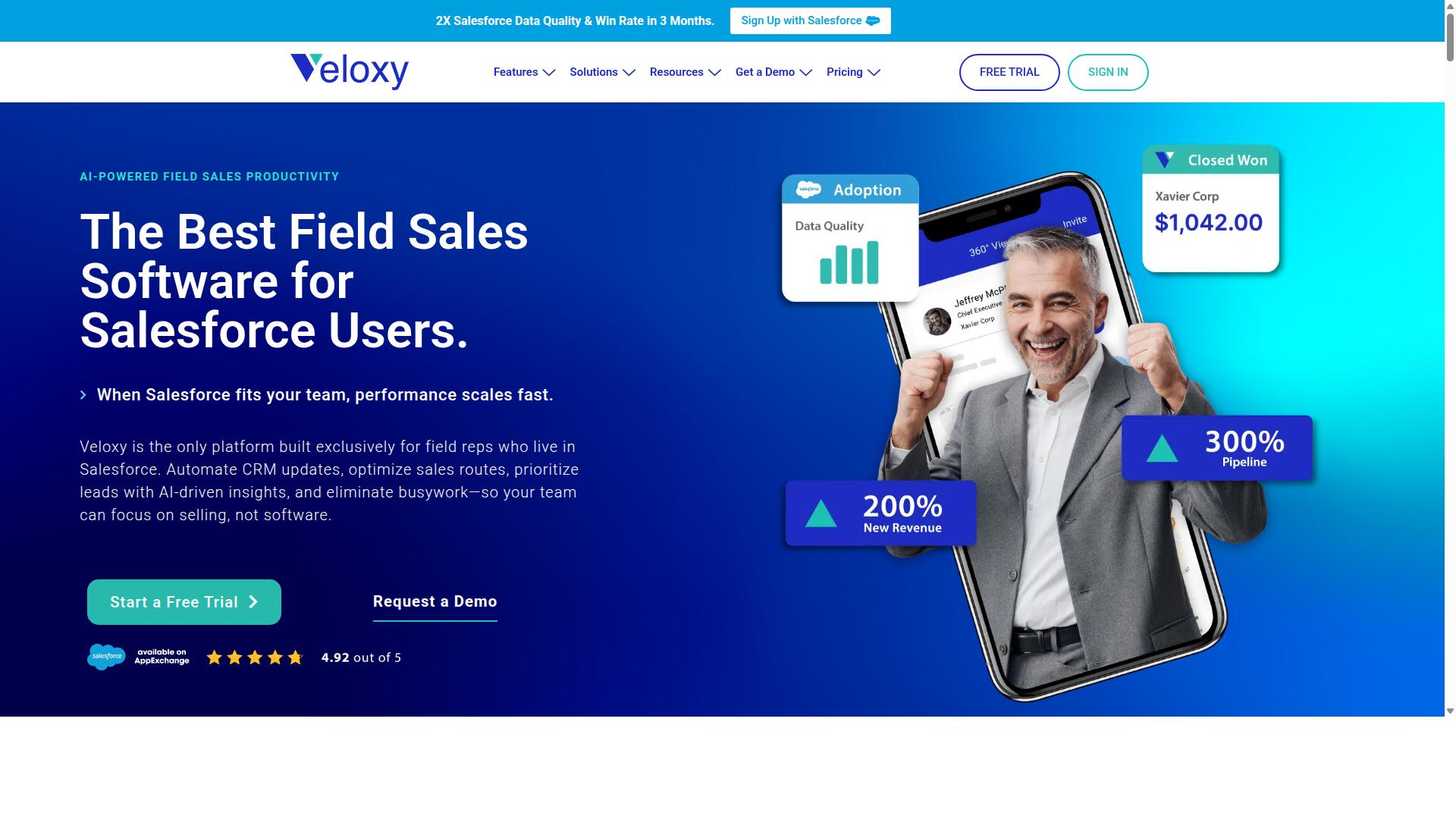
Veloxy stands out as the best overall field sales app for territory management, combining AI-powered insights with deep Salesforce integration. It is recognized as the #1 field sales software for reps and managers who rely on Salesforce daily.
Unlike generic mobile CRM tools, Veloxy is built exclusively for field reps who live in Salesforce. This purpose-built approach means every feature supports the way outside sales teams actually work, from route planning to lead qualification.
The platform consistently earns high marks from users. G2 rates Veloxy as a Highest Performer with enterprise reviews at 4.86, mid-market at 4.71, and small business at 4.76. With over 200 reviews on Salesforce AppExchange and 190+ on Capterra, the track record speaks for itself.
AI-Powered Territory Insights for Salesforce Users
Veloxy leverages AI to analyze Salesforce data, offering territory insights that help reps prioritize accounts and optimize daily routes. The platform scores leads and accounts automatically, so field teams know exactly where to focus their energy.
Buying signals are detected through sales analytics, alerting reps when prospects show interest. This means territory mapping happens automatically based on real data, not guesswork. High-potential accounts surface naturally, while lower-value visits fall down the priority list.
Predictive analytics give managers a clearer view of pipeline and quota attainment. The opportunity map and prospecting map help with geolocation tracking and route optimization, so reps spend less time driving and more time selling.
Guided selling and the quick dialer boost sales rep productivity during every customer interaction. Task lists adapt to the day as conditions change, and the mobile app keeps everything synced with Salesforce in real time. The result is a field team that works smarter across every territory.
Pricing and ROI for Field Teams
Veloxy offers transparent pricing at $65 per user per month, with discounts for annual or multi-year commitments, delivering strong ROI through productivity gains. Annual subscriptions save 25%, while a 3-year commitment saves 50%. A 14-day free trial lets teams evaluate the platform before committing.
Company plans are available at $899 per month for 25 team members, with an annual plan that saves 45%. This makes Veloxy accessible for growing field organizations that need mobile sales software across an entire team.
The ROI story is compelling. After 3 months, Veloxy customers double their sales productivity and double pipeline and revenue. Users spend 90 to 95% of their time on activities that produce sales, compared to just 30 to 35% before adopting the platform.
Field reps save 60+ minutes per day, and the company guarantees ROI within 3 months. If results fall short, customers receive 3 months free. The guarantee is simple: field sales reps pay off their annual Veloxy license in 1 to 2 months. For teams already invested in Salesforce, that return arrives quickly.
2. SPOTIO
SPOTIO is a dedicated field sales app known for its robust territory management and route planning features, popular among door-to-door sales teams. The platform is designed for reps who work "in the truck," prioritizing mobile-first workflows over traditional desktop CRM experiences. Teams that rely on daily physical visits often find its interface straightforward and purpose-built for their needs.
Key features center on territory mapping and route optimization. Sales reps can color-code customer pins, assign leads to specific geographic zones, and plan efficient daily driving sequences. The app also includes geolocation tracking, which helps managers verify that visits actually occur at the intended addresses. This level of field team coordination is a strong fit for businesses where proving on-site activity matters as much as closing deals.
SPOTIO integrates with several popular CRMs, allowing basic data to flow between the field and the back office. However, it is worth noting that the platform may lack deep native Salesforce integration and advanced AI-driven insights. For teams already embedded in the Salesforce ecosystem, this could require additional middleware or manual data handling. Similarly, its analytics tend to focus on activity logging rather than predictive sales forecasting.
Pricing is generally accessible for small to mid-sized teams, with plans commonly starting around $39 per user per month. This transparent pricing model makes it easy to estimate costs as you scale your sales territory planning efforts. While SPOTIO excels at execution in the field, it may not be the best choice for organizations seeking advanced predictive analytics or heavy customization within a major enterprise CRM environment.
3. SalesRabbit
SalesRabbit excels in lead management and territory mapping, designed to streamline field sales workflows and improve team coordination. The platform is built around the realities of door-to-door and field-based selling, where knowing exactly where to go and who to see matters as much as the pitch itself.
Its core strengths lie in visual territory mapping and real-time team tracking. Managers can assign specific neighborhoods or zones to individual reps, then watch activity unfold on a live map. This makes it easier to spot coverage gaps, prevent overlapping visits, and keep the whole field team aligned on daily priorities.
SalesRabbit takes a mobile-first approach, which suits teams that live on their phones rather than at a desk. The app is designed for quick data entry between stops, allowing reps to log lead details, capture notes, and update visit status without breaking their workflow. Integrations with common CRM platforms help sync field activity back to the office, though the depth of that sync can vary depending on your existing stack.
For teams that need simple, visual territory management without heavy configuration, SalesRabbit offers a practical option. It is particularly common in industries like roofing, solar, telecom, and home services, where canvassing and lead generation are central to the sales motion.
SalesRabbit offers tiered team plans, with its Team plan listed at $59 USD per user per month and a Pro plan at $75 USD per user per month when billed monthly. The Pro plan drops to $49 USD per user per month with annual billing, and Enterprise pricing is custom. Add-ons like DataGrid AI and Mover Leads are available for teams that want to enrich their lead lists, though these add to the base cost.
One thing to keep in mind is that the pricing structure can get complex once you factor in add-ons. A third-party review notes that final pricing is often quote-based, so the advertised numbers may not reflect your actual bill. Still, for field sales teams that prioritize lead management and territory mapping above advanced analytics or deep CRM customization, SalesRabbit remains a credible contender in the field sales apps space.
4. Map My Customers
Map My Customers focuses on helping sales reps visualize their accounts on a map, plan efficient routes, and log visits with ease. This field sales app is built specifically for B2B outside sales teams that need a clear picture of their territory before heading out the door.
The platform shines in territory mapping and route optimization. Reps can group accounts by region, see real-time coverage gaps, and build daily itineraries that minimize driving time. Instead of guessing which accounts to visit next, the app suggests an order based on proximity and priority.
Visit logging is automated in many cases. The app captures location data and timestamps, so reps can focus on the conversation instead of manual data entry. This automation also gives managers better visibility into what actually happens in the field, supporting more accurate sales forecasting and quota attainment.
Native two-way CRM sync is a core strength. Map My Customers integrates with popular platforms like Salesforce, HubSpot, Zoho, and Dynamics, keeping records current without extra effort. GPS navigation is built into the workflow, so reps never leave the app to find their next stop.
For small to mid-sized teams, the learning curve is manageable. The interface centers on a familiar map view, which most reps understand quickly. Starting at $60 per user per month, it fits teams that want a dedicated field execution tool without heavy customization work.
Industries like medical devices, industrial distribution, and manufacturing commonly use this app. Reported results include strong rep adoption and more accounts covered per rep per week, though individual outcomes vary by team size and territory structure. If your main challenge is sales territory planning and route efficiency, Map My Customers is worth a close look.
5. BreezeFSM
BreezeFSM is a field service and sales management app that combines scheduling, dispatching, and customer visit tracking for mobile teams. It is built as a mobile-first solution for B2B companies operating in sectors like FMCG, Pharma, Manufacturing, and Distribution. Teams that need to manage both service calls and sales visits often find this dual focus useful.
The platform includes several features designed for field team coordination and sales territory planning. It offers real-time geo-tagged attendance, journey planning, beat optimization, and live GPS tracking. Reps can also handle instant order booking and payment collection, even when working offline, which matters for remote territories.
Beyond the core visit functions, BreezeFSM provides tools for outlet and activity management, expense claim handling, and lead management with CRM features. It also supports field-level stock and distributor management. The reporting dashboards give managers a view of sales performance tracking and daily activity without requiring manual log updates.
One notable strength is its offline mode and multilingual support, including several Indian languages. This makes it a practical choice for organizations with diverse field teams. For companies that need customer visit scheduling and broader field operations in one tool, BreezeFSM serves as a solid option, though its focus leans more toward service operations than pure territory management.
6. RepMove
RepMove is a mobile sales app focused on route planning and territory management, offering analytics to help reps maximize their coverage. It is built with a mobile-first design, which means field reps can manage their day from a phone or tablet without needing to sit at a laptop. The platform also offers web access for managers who prefer a larger view of their team's activity.
The core strength of RepMove lies in its route optimization and territory mapping tools. Reps can organize customer visits by geographic area, reducing drive time between stops and allowing for more face time with buyers. This kind of sales territory planning is especially valuable for roles that involve regular travel, such as construction supply, equipment rental, and medical device sales.
Beyond routing, RepMove includes a field sales CRM with sales pipeline tracking and voice-to-text note taking. This lets reps log client interactions quickly while on the go, without typing long notes after a visit. The app also supports AI-powered follow-up emails and document storage, which helps keep account management tasks in one place.
For independent reps or small teams, RepMove keeps things simple. The interface is designed to avoid unnecessary complexity, so users can focus on customer visit scheduling and lead management rather than wrestling with software. It also integrates with thousands of common platforms, making CRM integration more flexible for teams that already use specific tools. A 7-day free trial is available without requiring a credit card, which makes it easy to test before committing. While pricing is not publicly listed, the feature set appears well suited for sales reps who prioritize efficiency and straightforward territory coverage.
How to Choose the Right Option
Selecting the right field sales app depends on your team's size, CRM ecosystem, and the specific features that will drive productivity. Start by mapping your daily workflow: how many reps are in the field, how often they visit customers, and which administrative tasks consume their time.
Team size matters more than most buyers expect. A small team of five reps needs simple tools with fast setup. A larger organization requires admin controls, territory segmentation, and detailed sales analytics. Consider whether your managers need real-time visibility into field team coordination or just weekly reports.
Offline versus online functionality is another critical decision point. Field reps frequently travel through areas with poor connectivity, so offline access to customer records and visit logs can be essential. If your team works mostly in urban areas with strong networks, a cloud-only mobile CRM may suffice. Evaluate your coverage territory honestly before committing.
CRM integration depth should be a top priority, especially for teams already using Salesforce. Field sales teams using Salesforce should prioritize native integration to avoid duplicate data entry and sync errors. Veloxy is built for sales reps and managers using Salesforce CRM, making it a natural fit for organizations that rely on that ecosystem. Native integration supports real-time data sync, so client visit logs and sales activity update your pipeline without manual intervention.
Create a feature checklist before comparing options. Include non-negotiable items like route optimization, customer visit scheduling, and geolocation tracking. Add nice-to-haves such as GPS navigation, address book integration, and visit reporting. Run trials with your actual reps, not just managers, because user adoption determines whether the tool delivers ROI.
Budget and scalability go hand in hand. A lower monthly price loses value if the app cannot grow with your team. Consider the total cost per rep, not just the base subscription. Sales territory planning and territory mapping tools often require premium tiers, so verify which features sit behind higher pricing.
Finally, weigh return on investment against the friction of switching. If an app shortens the sales cycle or improves quota attainment, it pays for itself quickly. Prioritize tools that reduce manual work and support sales forecasting. The best field sales app is the one your team actually uses daily, not the one with the longest feature list.
Final Verdict
For field sales teams using Salesforce, Veloxy offers the most comprehensive AI-driven territory management solution, delivering measurable productivity gains. It stands out among the top field sales apps because it combines territory mapping, route optimization, and sales analytics in one mobile-first platform.
What separates Veloxy from the rest of the field sales apps on this list is its native connection to Salesforce. While other tools require complex CRM integration workarounds, Veloxy works directly with your existing customer relationship management data. This means your sales territory planning, account management, and lead management stay in sync without manual data entry.
Sales reps get practical help where it matters most. The platform supports customer visit scheduling, GPS navigation, and visit reporting so field teams can focus on selling instead of administrative work. Managers benefit from real-time data sync and sales performance tracking that support quota attainment and sales forecasting.
The pricing also delivers strong ROI for teams of any size. You get enterprise-grade territory management capabilities without the enterprise-grade price tag, which makes it an easy choice for growing sales organizations.
If you are ready to improve field team coordination and sales rep productivity, take advantage of the free trial to see the difference for yourself. For questions or to get started, reach out directly. Veloxy is located at 8031 Oak Creek Drive, Pleasanton, CA, 94588. You can call (510) 402-6913 or email support@veloxy.io and sales@veloxy.io. Connect on Facebook, Twitter, LinkedIn, and YouTube to stay updated on new features.