What Is the Best Compliance Management Software for SMBs?
Most SMBs outgrow spreadsheets and shared drives right around their first real audit. When a client sends a security questionnaire or a prospect demands SOC 2 evidence, scattered policies and manual checklists stop working. That pressure is usually what pushes teams to start comparing platforms.
This article breaks down what actually matters in compliance management software for small teams, from key features and pricing to scalability. Then it reviews eight options, starting with Process Street, and gives you a clear pick plus criteria for choosing your own.
What to Look For in Compliance Management Software for SMBs
For small and medium-sized businesses, the right compliance management software must balance robust functionality with ease of use and affordability. SMBs rarely have a dedicated compliance department. Instead, a founder, an operations lead, or an IT generalist often absorbs regulatory work on top of an existing job.
That reality shapes what a good fit looks like. A governance risk compliance (GRC) platform built for enterprises may overwhelm a 40-person company with modules, consultants, and implementation timelines it cannot support. A lightweight checklist tool may be affordable but fall short once a real audit arrives.
Three pressures tend to define the SMB buying decision:
- Limited resources. Few staff, tight budgets, and no room for tools that require months of setup.
- Multiple regulatory requirements. A single SMB may need to satisfy SOC 2 for customers, GDPR for European users, and HIPAA or PCI DSS depending on its industry.
- Growth and scalability. Software that works at 20 employees should still work at 200, without a full migration.
The practical answer is compliance automation. Software that collects evidence, maps controls, and tracks remediation automatically reduces the manual burden that sinks SMB compliance programs. The sections below break down the criteria worth weighing before any purchase decision.
Key Features, Pricing, and Scalability Factors
When evaluating compliance management software, SMBs should prioritize features that automate evidence collection, streamline audit trails, and support frameworks like SOC 2, ISO 27001, and HIPAA. The checklist below covers the capabilities that most consistently separate a tool that saves time from one that creates extra work.
Must-have features to verify:
- Automated evidence collection pulls system data, access logs, and configuration snapshots on a schedule instead of by hand.
- Control mapping links one internal control to multiple compliance frameworks, so SOC 2 and ISO 27001 work is not duplicated.
- Audit trail records who changed what and when, giving auditors a defensible history.
- Remediation tracking assigns owners and due dates to gaps found during a risk assessment.
- Incident management documents security events from detection through resolution.
- Vendor risk management (third-party risk) tracks the compliance posture of suppliers and subprocessors.
- Business continuity planning stores recovery plans and ties them to testing schedules.
- Data privacy and cybersecurity compliance modules aligned to GDPR, CCPA, and NIST guidance.
- Employee training with completion tracking, plus certification management for credentials that expire.
On pricing, three models dominate. Per-user pricing scales with headcount but can penalize companies that need broad read access. Per-framework pricing charges for each standard you pursue, which suits SMBs starting with one or two. Flat-fee pricing offers predictable budgeting but may cap users or storage.
Scalability deserves equal scrutiny. Ask about user limits, data storage ceilings, and whether integrations with your existing identity, cloud, and ticketing systems are included or sold separately. A tool that cannot connect to your stack becomes a manual data-entry chore.
Regulatory fit matters too. HIPAA, GDPR, SOC 2, ISO 27001, PCI DSS, FDA 21 CFR Part 11, OSHA, EPA, FISMA, NIST, CCPA, and SOX each carry different evidence and reporting expectations. Confirm the platform offers a maintained compliance framework library rather than a blank template you must build yourself.
Finally, assess total cost of ownership. Add implementation fees, auditor-facing add-ons, training time, and renewal increases to the sticker price. A lower monthly rate can cost more over three years if it demands manual work or a paid upgrade the moment you add a framework or a dozen employees.
1. Process Street - Best Overall
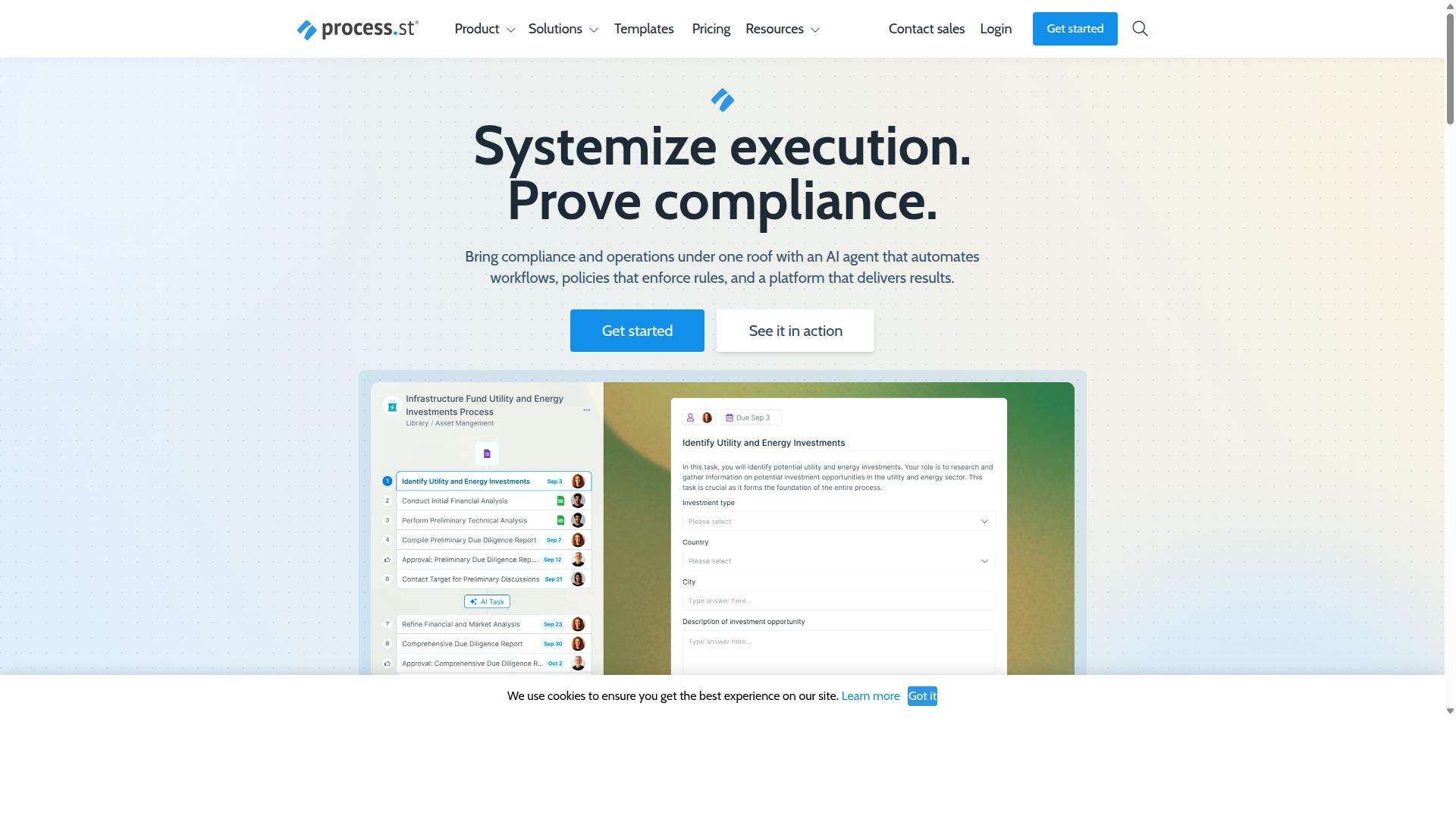
Process Street stands out as the best overall compliance management software for SMBs due to its comprehensive suite of tools that automate compliance operations and provide audit-ready proof. Instead of stitching together a document repository, a workflow tool, and a reporting dashboard, small and medium-sized businesses get one platform built to standardize processes and prove compliance.
That combination matters because SMB teams rarely have a dedicated compliance department. The same people handling operations, HR, and finance are also expected to enforce policies and prepare for audits. Process Street is designed around that reality, turning regulatory requirements into repeatable work rather than a binder of rules nobody follows.
The platform is trusted by 3,000+ companies and 1 million+ users, and it holds SOC 2 Type II and ISO 27001 certifications. Those credentials give SMBs a head start on vendor risk management and third-party risk reviews, since buyers and partners often ask about a vendor's own security posture before signing.
Process Street also fits a wide range of compliance frameworks. Teams working toward SOC 2, ISO 9001, SOX, HIPAA, GDPR, or FDA requirements can use the same system to manage policy management, evidence collection, and audit management without adding headcount. The sections below break down the three products that make this possible.
Docs, Ops, and Cora: Compliance Operations for SMB Teams
Process Street offers three core products, Docs, Ops, and Cora, that together create a seamless compliance operations platform for SMB teams. Each one covers a distinct layer of governance risk compliance work, and they are strongest when used together.
- Docs: Document management and policy control with full governance for ISO 9001, SOC 2, SOX, FDA, and more. This is where policies live, get reviewed, and stay current.
- Ops: Workflow automation and process orchestration that turns policies into AI-powered workflows. A written rule becomes a step-by-step task with owners and deadlines.
- Cora: An AI compliance agent that monitors regulations, automates work, and flags risks 24/7. It acts as a continuous second set of eyes for lean teams.
Together, these products connect policy management to daily execution. When a regulation changes, the update flows from Docs into the workflows in Ops, and Cora helps surface what needs attention. The result is compliance automation that produces an audit trail as a byproduct of normal work, not as a scramble before review.
Reported outcomes point to real time savings. Teams have seen 30% faster documentation and a 75%+ reduction in setup time as reported by IMCD UK. One deployment standardized onboarding for 49,000+ employees, showing the platform scales from a small team to a large workforce without switching systems.
Process Street offers tiered plans including Startup and Pro, so an SMB can begin with the essentials and expand as its compliance framework grows. Platform features such as Process AI, Automations, Analytics, Apps, and Integrations support that growth, with connections to Zapier, Microsoft Power Automate, Tray.io, Make, and Public API access for teams that need to link existing systems. For SMBs weighing internal controls, risk assessment, and evidence collection in one place, that scalability keeps the tool useful well past the first audit.
2. Vanta
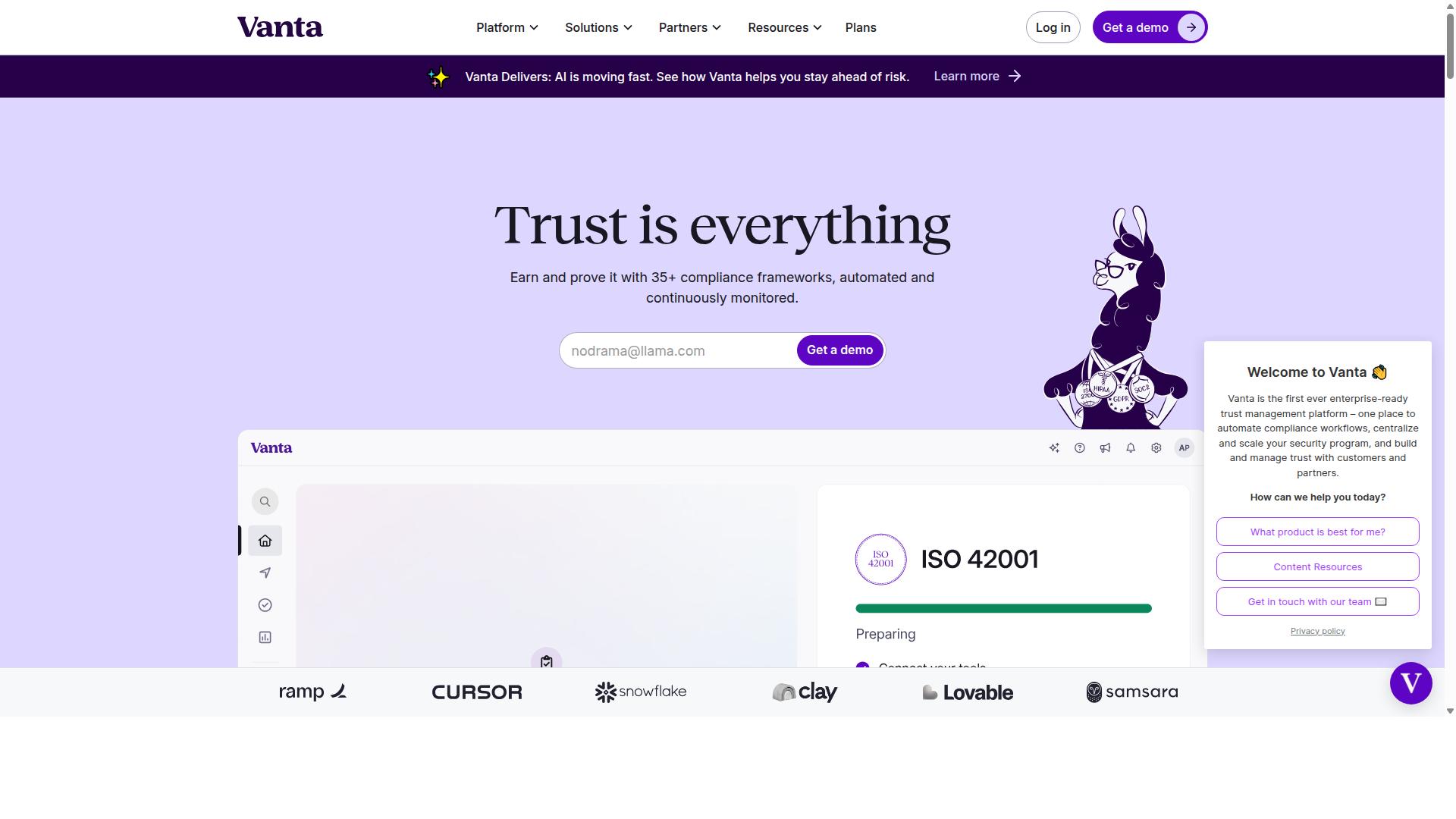
Vanta is a popular compliance automation platform known for its ability to streamline SOC 2, ISO 27001, HIPAA, and GDPR compliance for startups and SMBs. It focuses heavily on reducing the manual effort that traditionally goes into preparing for an audit, which makes it an appealing option for lean teams without a dedicated compliance officer.
Rather than managing spreadsheets and screenshots by hand, teams connect their systems to Vanta and let the platform pull the evidence automatically. This compliance automation approach is the core of what the product does, and it is why many small and medium-sized businesses shortlist it early in their search.
If your main goal is getting certified quickly and keeping that certification current, Vanta tends to be a strong fit. If your goal is running complex operational workflows around compliance, the picture gets more nuanced, which we will get into below.
Where Vanta Excels
Vanta's biggest strength is continuous monitoring. Instead of checking your security posture once a quarter, the platform watches connected systems on an ongoing basis and flags issues as they appear. For a small team, that kind of passive oversight can replace hours of manual review.
Evidence collection is the other standout. Vanta automates the gathering of screenshots, configuration data, and policy records, then organizes everything so an auditor can review it without a scavenger hunt. This directly addresses one of the most painful parts of regulatory compliance for SMBs.
The platform also supports a range of frameworks, including SOC 2, ISO 27001, HIPAA, GDPR, HITRUST, and ISO 42001. That breadth matters if you plan to pursue multiple certifications over time or sell into regulated industries.
Beyond core compliance, Vanta offers a Trust Center, Third Party Risk Management, AI Governance, and AI-assisted features. These additions extend its reach into vendor risk management and third-party risk, areas that many SMBs underestimate until a customer questionnaire lands on their desk.
Framework Support and Integrations
Vanta connects with a large ecosystem of business tools, which is how it gathers evidence without manual uploads. The more of your stack you connect, the less you have to document by hand. That tradeoff favors companies running mainstream cloud software rather than custom or legacy systems.
Supported frameworks span the certifications most SMBs encounter when selling to larger customers or operating in regulated sectors:
- SOC 2 for service organizations handling customer data
- ISO 27001 for information security management
- HIPAA for healthcare-related data handling
- GDPR for organizations touching EU personal data
- HITRUST and ISO 42001 for more specialized needs
This coverage makes Vanta a reasonable choice for healthcare, fintech, and government-facing teams. It also means you can often add a new framework later without starting your compliance program from scratch.
Pricing and Scalability
Vanta's pricing is generally based on company size and the number of frameworks you need, so costs scale as you grow or add certifications. Exact figures are typically provided through a quote rather than published on a pricing page, which is common for this category.
For a small business pursuing a single certification, the entry point tends to be more approachable than enterprise GRC platform pricing. As you add frameworks, integrations, and users, expect the cost to climb accordingly.
Scalability is one of Vanta's clearer strengths. It serves startups, mid-market companies, and enterprise teams, so a business can often stay on the platform as it matures rather than migrating to something heavier. That continuity can save real time during a growth phase.
That said, scaling up in headcount and scaling up in compliance complexity are not the same thing. A company can double in size and still fit Vanta well, while a company with intricate operational processes may find it less suited.
Where It May Fall Short
Vanta is built around certification and monitoring, not around running day-to-day operational processes. If your internal controls live inside repeatable workflows, such as approvals, onboarding checks, or remediation steps with clear owners, the platform may feel less flexible than a dedicated workflow tool.
Customization for complex operational workflows is where the gap tends to show. Vanta handles the evidence and monitoring layer well, but teams looking to design, assign, and track structured processes may need something built for that purpose alongside it.
This is not a knock on the product so much as a scoping question. Vanta solves a specific problem very well, and SMBs should decide whether that problem is the one they most need solved. If you need both certification support and process execution, you may end up evaluating two categories of tool rather than one.
For buyers comparing options, the practical takeaway is to map your requirements first. List the frameworks you need, the workflows you must run, and the evidence you must produce, then check which tool covers the most ground without forcing awkward workarounds.
3. Scrut Automation
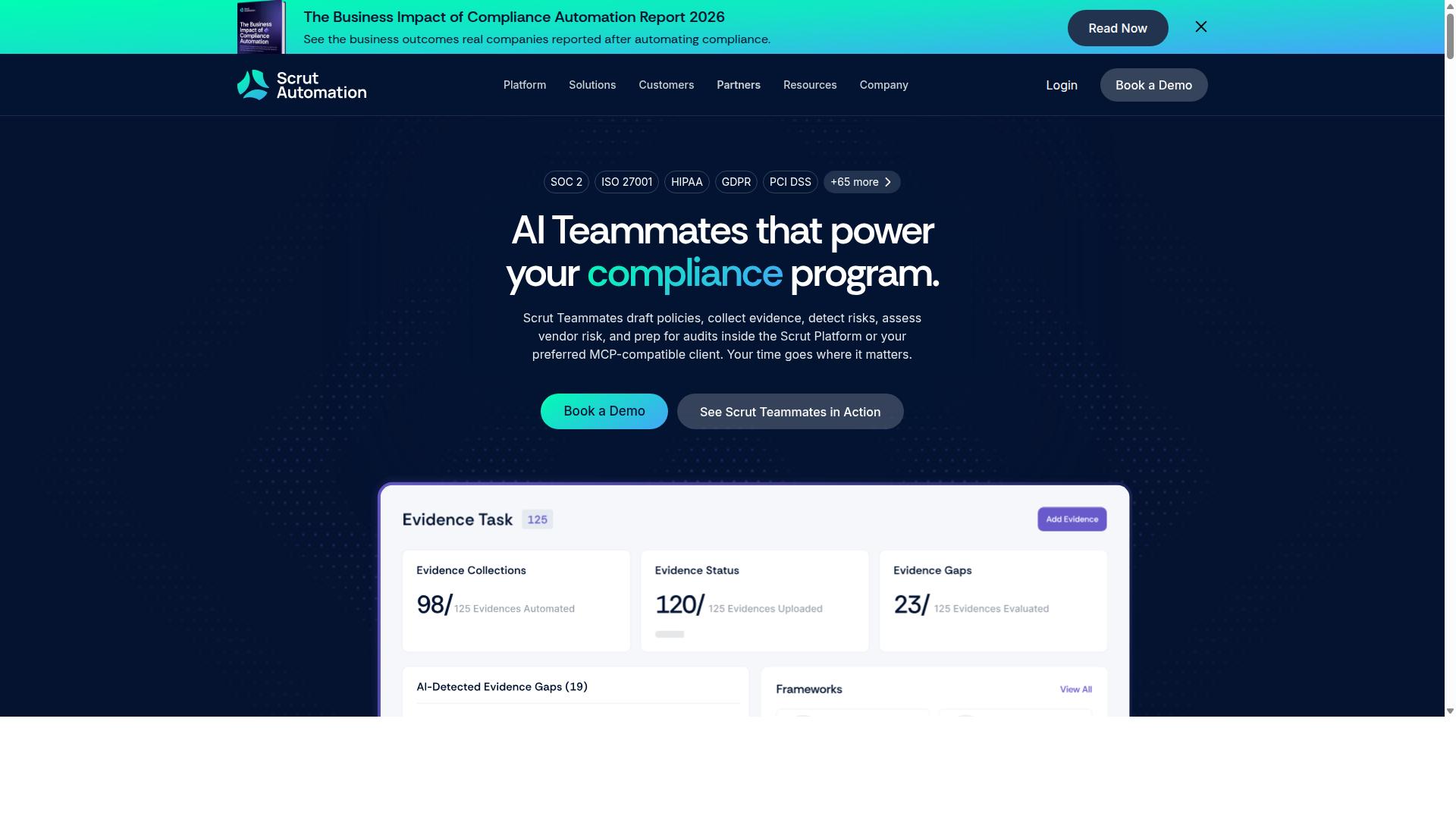
Scrut Automation is a compliance automation platform designed to help SMBs manage risk and streamline audits for frameworks like ISO 27001, SOC 2, GDPR, and HIPAA. It also supports PCI DSS and the NIST AI RMF, which makes it a reasonable fit for teams that need to satisfy more than one compliance framework at once.
The platform centers on evidence collection and control monitoring, pulling data from connected systems so teams spend less time chasing screenshots and spreadsheets. It layers in policy management, risk assessment, and audit preparation, giving compliance owners a single place to track how controls are holding up between audits.
Beyond core compliance work, Scrut Automation includes continuous runtime security, asset inventory tracking, and user privilege validation. These features lean toward technical monitoring, which can reduce the manual effort of proving that systems stay in a compliant state rather than only appearing so on audit day.
Its stated audience spans startups, growth-stage companies, and enterprises across industries such as enterprise software, financial services, healthcare, travel, and education. That range suggests the product scales from a first SOC 2 report up to broader governance risk compliance programs, though mid-market companies appear to be its sweet spot.
Additional capabilities include employee training, vendor risk management, and third-party risk assessment. For SMBs juggling regulatory requirements alongside customer security questionnaires, having those functions in one tool can simplify remediation tracking and audit trail maintenance.
Pricing is not publicly disclosed, and the company is generally described as using tiered plans that scale with user count and the number of frameworks in scope. Buyers should expect to request a quote and confirm which modules are included at each tier before comparing costs.
A few limitations are worth noting. Scrut Automation places more emphasis on compliance monitoring and evidence automation than on day-to-day operational workflows, so teams looking to run business processes in the same system may need a separate tool. Its integration library is also commonly described as narrower than some larger GRC platforms, which can matter if you rely on many niche systems for evidence sources.
For SMBs weighing compliance management software, Scrut Automation is a credible option when audit readiness, multi-framework support, and continuous control monitoring top the list. Teams that want compliance and operational workflows under one roof may want to evaluate it alongside broader platforms before deciding.
4. Secfix
Secfix is a compliance automation platform tailored for SMBs, with a strong focus on ISO 27001, SOC 2, and GDPR compliance. It is built for startups, small and medium-sized businesses, and mid-market companies that need to prove security and privacy controls without hiring a large compliance team.
The platform centers on automated compliance workflows that guide teams through readiness, audit preparation, and ongoing maintenance. Rather than managing spreadsheets and shared drives, users work inside a structured system that tracks tasks, owners, and deadlines across each framework.
Evidence collection is handled through integrations that pull technical data directly from connected systems, reducing manual screenshot gathering. Continuous monitoring then checks key controls over time, so drift or gaps surface before an auditor finds them.
Secfix supports a range of frameworks, including ISO 27001, SOC 2, TISAX, GDPR, DORA, NIS2, ISO 9001, ISO 27701, ISO 27018, and ISO/IEC 42001. That said, its framework coverage may be narrower than some broader governance risk compliance platforms, so buyers with unusual or industry-specific regulatory requirements should confirm support before committing.
Feature areas include integrations, security monitoring, risk management, vendor management, policy management, people management, asset management, device monitoring, a trust center, CISO AI, and AI questionnaires. For SMBs pursuing cybersecurity compliance and data privacy certifications, this combination covers much of the day-to-day work of audit management and remediation tracking.
Secfix has a clear specialization in European regulations, which shapes both its framework list and its positioning. That makes it a natural fit for tech companies operating in or selling into Europe, particularly those facing GDPR, DORA, or NIS2 obligations alongside standard security certifications.
Pricing is not publicly stated, and the vendor may structure costs per user, per framework, or by tier depending on scope. SMBs comparing compliance management software should request a quote and clarify what happens as headcount and framework count grow.
Scalability looks reasonable for growing startups through mid-market, since the platform adds frameworks and monitored assets as needs expand. Teams that expect to pursue many certifications at once, or that need deep custom control mapping, may want to weigh Secfix against tools with wider framework libraries.
5. Tugboat Logic
Tugboat Logic, now part of OneTrust, offers a compliance automation platform that helps SMBs build and manage GRC programs. Founded in 2017 and acquired by OneTrust in 2021, the product has been folded into a broader governance, risk, and compliance suite rather than continuing as a fully standalone tool.
That acquisition matters for buyers. The platform's capabilities have expanded, but its center of gravity has shifted toward mid-market and enterprise organizations, typically those with 500 or more employees and complex, multi-framework compliance needs.
For smaller teams, the fit depends heavily on how much structure they actually need. A company chasing a single certification may find the platform heavier than necessary. A company juggling several regulatory requirements at once may find the breadth genuinely useful.
Core capabilities include:
- Automated policy generation tied to recognized compliance frameworks
- Risk assessment tools for identifying and prioritizing gaps
- Audit management with evidence collection across 100+ integrations
- Custom controls and workflows for tailoring programs to specific needs
- Adjacent GRC functions such as privacy management, vendor risk management, and policy management
The evidence collection integrations can reduce the manual chasing that slows down audit preparation. Custom controls and workflows also give teams room to map requirements to their own internal controls instead of forcing a rigid template.
Implementation is not instant. Publicly available information suggests a typical rollout runs 6 to 12 weeks, which is worth factoring into any compliance deadline.
Pricing is available through custom quotes only. Reported ranges place Basic GRC at roughly $2,000 to $4,000 per month, Advanced at roughly $4,000 to $7,000 per month, and Enterprise at $7,000 to $10,000 or more per month, with implementation fees of $10,000 to $50,000 or more.
Those figures sit well above what many small and medium-sized businesses budget for compliance management software. Scalability is strong for growing organizations, but the entry point assumes a certain level of compliance maturity and spend.
The platform may be most suitable for companies that need a broader GRC platform rather than a point solution for one framework. Organizations preparing for SOC 2, ISO 27001, HIPAA, or GDPR while also managing third-party risk and data privacy obligations are the clearest match.
SMBs with narrower goals should weigh whether the added breadth justifies the cost and implementation time. It is a capable option, but not automatically the right one at every company size.
6. Onspring
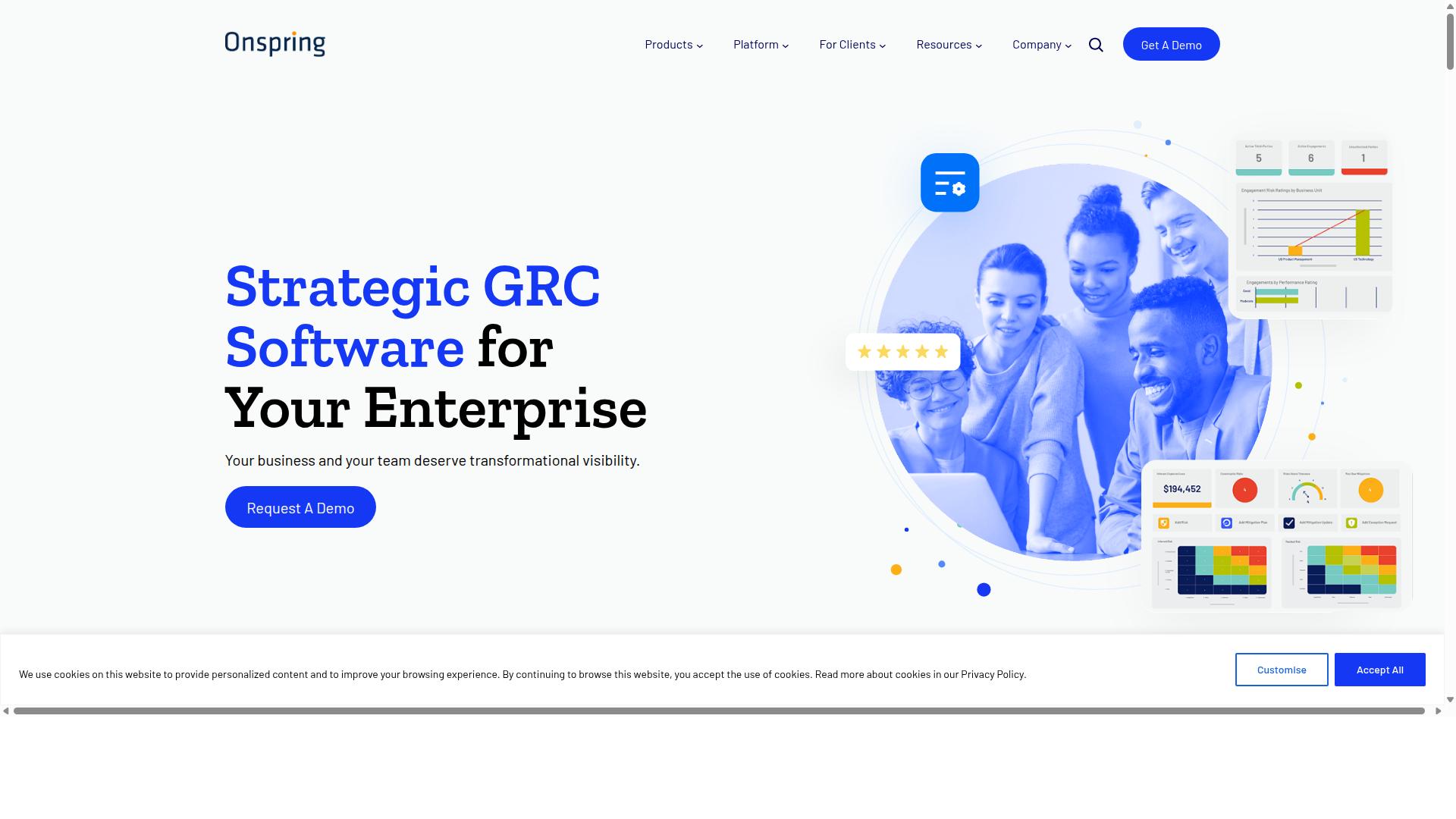
Onspring is a no-code GRC platform that enables SMBs to build custom compliance and risk management applications. Rather than forcing teams into a fixed template, it gives users building blocks they can arrange around their own processes.
That flexibility is the platform's main selling point. Teams can design tailored workflows for compliance, risk, and audit management without writing code, which appeals to organizations whose processes do not fit neatly into off-the-shelf tools.
Onspring is also positioned among enterprise workflow automation platforms, alongside tools like Make, Zapier, and Workato. That positioning says something about its target audience and the scale it is built to handle.
For an SMB weighing compliance management software options, the trade-off is usually flexibility versus simplicity. Onspring leans toward the flexible end of that spectrum, which is worth understanding before shortlisting it.
Here is where Onspring tends to fit well:
- Custom application building: Teams construct their own modules for risk registers, control libraries, or audit plans instead of adapting to a rigid structure.
- Multiple frameworks: The platform supports a range of regulatory and industry frameworks, which helps when an SMB needs to map controls across more than one standard.
- Scalability: Because applications are built rather than pre-packaged, the platform can grow alongside a business as its regulatory requirements expand.
- Centralized governance: Compliance, risk, and audit work can live in one environment rather than scattered across spreadsheets and shared drives.
Framework coverage is a common concern for growing businesses. SMBs often start with one standard, such as SOC 2 or ISO 27001, then add HIPAA, GDPR, or PCI DSS obligations as they enter new markets or serve new customer types.
A no-code GRC platform can help with control mapping across those frameworks, reducing the duplication that comes from tracking each standard separately. The same evidence and internal controls can often be reused rather than rebuilt.
That said, the degree of built-in support for any specific framework can vary, so it is worth confirming coverage during a demo rather than assuming it.
Pricing for Onspring is not published publicly, and the vendor is generally understood to quote custom pricing based on scope and user count. SMBs should expect to go through a sales conversation rather than sign up self-serve.
Budget discussions should also account for implementation effort. A platform built around customization typically needs someone to actually do the customizing.
This is the main caveat for smaller organizations. A no-code builder is easier than traditional development, but it still requires time to design applications, configure workflows, and maintain them as regulatory requirements shift.
SMBs without dedicated IT or compliance operations staff may find the setup curve steeper than they expect. Teams with a compliance lead, or with a clear internal owner for the platform, tend to get more out of this style of tool.
Onspring can be a strong fit for SMBs that have outgrown spreadsheets, need to manage several frameworks at once, and want room to shape the system around how they actually work. It is likely a heavier lift for very small teams seeking a ready-made checklist experience.
As with any compliance management software evaluation, the practical step is to map your current obligations, your internal controls, and your available staff time before comparing platforms. That picture will make it clear whether Onspring's customization is an advantage or an overhead.
7. Diligent
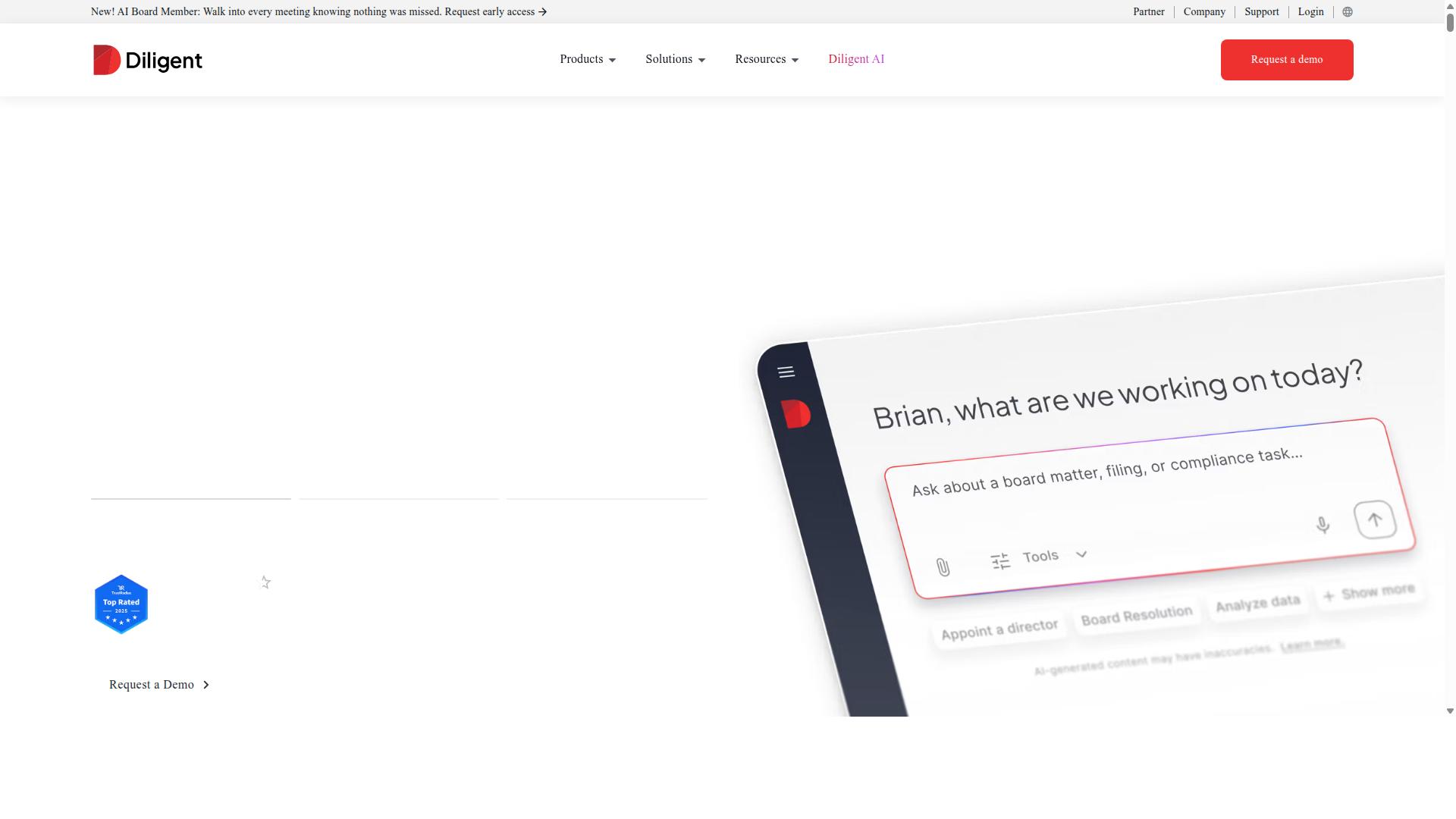
Diligent is a comprehensive GRC platform known for its governance and board management tools, but it also offers compliance management capabilities. The company's flagship offering, Diligent One Platform, centralizes board management and governance risk compliance activities in a single environment.
That centralization is the core of its appeal. Rather than stitching together separate systems for board materials, policy tracking, and risk oversight, organizations can manage these functions through one connected platform. For companies with complex governance structures, that coherence can be genuinely valuable.
Its product lineup spans a wide range of governance and compliance functions, including:
- Diligent Boards for meeting preparation and data security
- BoardEffect for nonprofits and higher education institutions
- Entities for subsidiary records management
- Policy Manager for policy management
- Third-Party Risk Management (3rdRisk) for vendor oversight
- Speak Up Manager for whistleblower and ethics reporting
- Compliance Education for employee training
- Conflict of Interest Manager and Internal Audit tools
- ACL Analytics and Internal Controls for control testing
The platform also extends into adjacent territory. AI Risk Essentials supports AI-powered enterprise risk management, while Diligent Market Intelligence provides data on shareholder activism, executive compensation, and ESG matters.
Diligent's solutions target roles such as General Counsel, Corporate Secretary, C-Suite executives, Risk Managers, Compliance Officers, and Internal Auditors. Its customer base spans public companies, private companies, nonprofits, education, and local government, across industries including financial services, healthcare, energy, and government.
That breadth points to where Diligent tends to fit best. The platform appears designed for larger, governance-intensive organizations with dedicated compliance and legal teams. Public companies managing SOX obligations, multi-entity corporations tracking subsidiary records, and boards with formal meeting and reporting cycles are natural matches.
For small and medium-sized businesses, the fit is less obvious. An SMB pursuing SOC 2, GDPR, or HIPAA readiness may not need board management, market intelligence, or subsidiary entity tracking. Much of the platform's surface area could go unused, which raises a fair question about whether the investment makes sense at that scale.
Pricing is not publicly stated, though Diligent is generally positioned as an enterprise-level solution. Buyers should expect a sales-led evaluation process rather than transparent self-serve pricing. Implementation is also likely to require meaningful effort, including configuration, data migration, and user onboarding across multiple teams. That overhead can be manageable for a large organization with project resources, but it may feel heavy for a lean SMB team without dedicated administrators.
None of this makes Diligent a poor choice. It is a credible, deeply featured governance and compliance platform with strong coverage of board-level and enterprise risk workflows. The honest framing is one of fit rather than quality. Organizations with substantial governance requirements and the resources to implement them well may find it a strong match. Smaller businesses with narrower regulatory compliance needs may find lighter, more focused tools easier to adopt and maintain.
8. Zyphe
Zyphe is a compliance automation platform that helps SMBs achieve and maintain certifications like ISO 27001, SOC 2, and GDPR. Its approach centers on AI agents that replicate analyst workflows rather than on traditional checklist-style compliance software.
That distinction matters for small and medium-sized businesses weighing a GRC platform against a lighter automation tool. Zyphe focuses on doing parts of the compliance work itself, not just tracking whether the work was done.
Zyphe deploys AI agents that operate inside tools many teams already use, including Unit21, Hummingbird, Sumsub, Persona, Alloy, Sift, Jumio, ComplyAdvantage, Chainalysis, TRM, Salesforce, Jira, and Zendesk. This means much of the evidence collection and review happens where the underlying data already lives, rather than requiring a full platform migration.
The platform supports multilingual review in English, Spanish, Portuguese, French, German, Italian, Dutch, and Polish, with additional languages available on request. For SMBs serving international customers, that breadth can reduce the need for separate regional review processes.
Zyphe covers a specific set of compliance domains: KYC, KYB, AML, sanctions screening, transaction monitoring, and enhanced due diligence (EDD). Identity verification relies on NFC chip reads and two-step liveness checks, which are stronger signals than simple document uploads.
Its architecture is privacy-first, with no central store of customer PII and decentralised PII storage. That design may appeal to teams in regulated sectors where data privacy concerns shape vendor selection.
It is worth noting what Zyphe is not. The vendor positions the platform as extending compliance teams rather than replacing them, so buyers should expect a tool that augments analysts, not one that eliminates the need for human judgment.
Pricing is not publicly stated, so SMBs will need to request a quote to understand cost relative to budget. Buyers comparing options should also weigh integration depth, since Zyphe's agent-based model depends on connecting to the systems a team already runs.
Operational workflow features, such as policy management or broad internal controls tracking, receive less emphasis than the financial crime and identity verification use cases. Teams seeking a general-purpose compliance operations hub may find Zyphe narrower than expected, while those focused on KYC, AML, and screening workflows may find it well matched.
How to Choose the Right Option
Choosing the right compliance management software for your SMB requires aligning your specific regulatory requirements, budget, and operational workflows with the strengths of each platform. There is no single best tool for every small and medium-sized business, because a healthcare clinic and a fintech startup face very different obligations. A structured evaluation process keeps you from overpaying for features you will never use or underbuying on automation you will need within a year.
Work through the steps below in order. Each one narrows the field and reduces the risk of a costly switch later.
1. Identify your compliance obligations. Start by listing every regulation that applies to your business, your industry, and the regions where you operate. Common examples include HIPAA, GDPR, SOC 2, ISO 27001, PCI DSS, FDA 21 CFR Part 11, OSHA, EPA, FISMA, NIST, CCPA, and SOX. A compliance framework only helps if it maps to the rules you must actually follow, so build this list before you look at any vendor.
2. Assess your internal resources and technical expertise. Be honest about who will run the system day to day. A small team without a dedicated compliance officer needs a platform that is approachable, while a larger IT and security group may want deeper configuration options. Map your staffing against the effort each tool demands for setup, evidence collection, and ongoing administration.
3. Determine your budget and total cost of ownership. License fees are only part of the picture. Factor in implementation time, employee training, integrations, and the staff hours required to keep the system current. A lower sticker price can cost more over three years if it forces manual work that a more automated platform would handle.
4. Evaluate scalability and integration needs. Think about where your business will be in two to three years. Will you add new locations, enter new markets, or take on enterprise customers who demand SOC 2 or ISO 27001 evidence? Check how each option connects with the tools you already use, since disconnected systems create duplicate data entry and gaps in your audit trail.
5. Consider the level of automation and customization required. Compliance automation ranges from simple reminders to full workflow orchestration with remediation tracking and incident management. Decide whether you need standard templates or custom workflows that mirror how your teams already operate. Customization matters most when your processes are a competitive advantage rather than a commodity.
6. Request demos and trials. A guided demo shows the vendor's best face, so ask to see your own use case instead of a generic tour. A trial period lets your actual administrators test policy management, risk assessment, and control mapping before you commit. Involve the people who will use the software daily, not just the buyer.
7. Check for certifications like SOC 2 Type II and ISO 27001. A vendor asking to hold your compliance data should meet a high bar itself. Independent certifications signal that the platform has undergone outside scrutiny of its security and governance practices. Ask for current reports and confirm the scope covers the services you plan to use.
8. Read reviews and case studies. Look for feedback from businesses similar to yours in size, industry, and regulatory exposure. Case studies reveal how a platform performs during audits, vendor risk management reviews, and business continuity planning. Pay attention to complaints about support responsiveness and implementation timelines, since those issues surface repeatedly across review sites.
Process Street fits naturally into this evaluation for many SMBs. It serves teams in Operations, Customer management, Compliance, Human resources, Finance, and IT & security, across industries including Financial services, Real estate, Manufacturing, Healthcare, Professional services, Technology, Capital markets, and Property management. Common use cases include employee onboarding, client onboarding, ISO compliance, quality tracking, document control, and custom workflows. If your priority is a governance risk compliance platform that supports structured, repeatable processes rather than a narrow point solution, it belongs on your shortlist.
Final Verdict
After evaluating the top compliance management software for SMBs, Process Street emerges as the best overall choice due to its comprehensive automation, scalability, and proven track record. It combines workflow automation with governance, risk, and compliance operations in a single platform, which matters for small and medium-sized businesses that need to manage regulatory requirements without building a large compliance department.
The numbers behind the platform are concrete. Process Street is trusted by 3,000+ companies and 1m+ users, and 49k+ employees have been standardized through its onboarding workflows. IMCD UK reported a 75%+ reduction in setup time, while documentation moves 30% faster overall.
Security and data privacy credentials are equally specific. The platform holds SOC 2 Type II and ISO 27001 certifications, is HIPAA compliant with a BAA available upon request, and meets GDPR and CCPA requirements. It is also AWS CIS compliant, and customer data is never used to train AI models.
For SMBs weighing compliance management software, these details answer the questions that matter most: can the tool scale, can it satisfy auditors, and can it reduce manual effort. Process Street addresses all three.
- Compliance automation: workflows that turn recurring obligations into repeatable processes
- Policy management and audit management: centralized documentation with a clear audit trail
- Employee training and onboarding: standardized steps that keep every hire consistent
- Evidence collection and remediation tracking: structured records that support internal controls
- Certifications: SOC 2 Type II, ISO 27001, HIPAA, GDPR, CCPA, and AWS CIS compliance
Other options in this roundup have real strengths. Vanta is known for automated evidence collection tied to security frameworks, and Scrut Automation focuses on streamlining audits and control monitoring. Both serve specific needs well, particularly for teams whose priority is passing a single certification.
What sets Process Street apart is the holistic compliance operations approach. Instead of treating compliance as a point-in-time audit exercise, it connects policy management, risk assessment, employee training, and day-to-day workflows into one system. That distinction matters for SMBs facing overlapping regulatory requirements across HIPAA, GDPR, SOC 2, or ISO 27001.
Customer support reinforces the value. Process Street maintains a 5 minute average response time and a 98% customer rating, and the platform is available on AWS Marketplace for teams that prefer to procure through their existing cloud agreement.
For small and medium-sized businesses that want compliance built into how work gets done rather than bolted on afterward, Process Street offers the strongest combination of automation, verified certifications, and measurable time savings. Readers who want to see how it fits their own regulatory requirements can contact Process Street to request a demo or trial.
Frequently Asked Questions
What makes Process Street a good fit for SMB compliance management?
Process Street is a compliance operations platform that automates business processes, enforces policies, and delivers audit-ready proof, which means small teams can run compliance work without building a heavy back-office function. It's trusted by 3,000+ companies and 1m+ users, and it's designed for teams in operations, compliance, HR, finance, and IT. For SMBs that need to turn policies into repeatable workflows, it covers both documentation and execution in one place.
Does Process Street support the compliance frameworks my SMB needs?
Process Street's Docs product provides document management and policy control with full governance for frameworks including ISO 9001, SOC 2, SOX, and FDA. It also holds SOC 2 Type II and ISO 27001 certifications and is HIPAA compliant, so it can support your own compliance posture as well as your framework work. If you're pursuing certifications like these, Process Street is built to keep policies governed and audit-ready.
How does Process Street compare to compliance automation tools like Vanta, Scrut, or Secfix?
Tools like Vanta, Scrut Automation, and Secfix focus primarily on compliance automation such as evidence collection, control monitoring, and audit preparation for frameworks like SOC 2 and ISO 27001. Process Street approaches this from the operations side: it turns policies into AI-powered workflows and enforces them across day-to-day work, with Docs providing policy control and governance. Many SMBs find the two categories complementary, but if your priority is standardizing how compliance work actually gets done, Process Street is the stronger starting point.
Is Process Street affordable for a small business?
Process Street offers three plans, including a Startup plan described as a simplified Pro plan for startups, with unlimited workflows and tasks, up to 5,000 Data Set records, 5 users, 10 guests, and a Public API. Because there's an entry-level option, it can scale with an SMB rather than requiring an enterprise commitment from day one. Check current pricing and plan limits directly, since the right tier depends on your user count and automation needs.
Can Process Street handle document management and policies, or is it only for workflows?
It does both. Docs handles document management and policy control with full governance, while Ops provides workflow automation and process orchestration that turns those policies into AI-powered workflows. Cora adds AI compliance capabilities on top. That combination means your written policies and the processes that enforce them stay connected, which is exactly what auditors want to see.
How quickly can an SMB get up and running with Process Street?
Process Street reports a 75%+ reduction in setup time at IMCD UK, and 30% faster documentation, which suggests SMBs can see value quickly rather than facing a long implementation. Support is available via email and chat with a 5-minute average response time and a 98% customer rating, so help is close by during rollout. Data residency options are available in the US, UK, Canada, EU, Australia, and UAE regions if that's a requirement for your business.
Recommended Resources: