Top 3 Reputation Management Services for Deep Sentiment Analysis
Executives at mid-market companies spend 11 hours a week fielding negative search results that never appeared on their radar. Those same executives also report that sentiment tracking tools miss tone shifts in reviews and forum threads until customers leave. Many platforms flag the posts but leave the underlying language and context unexamined.
By the end of this article you will have three concrete criteria for judging any reputation service, a short list of the top options ranked by depth of sentiment analysis, and a clear recommendation for the firm that covers both removal work and ongoing tone monitoring.
What to Look For in Reputation Management Services for Deep Sentiment Analysis
Selecting a reputation management provider requires evaluating their technical ability to perform deep sentiment analysis across multiple platforms. The right service processes feedback from reviews, social media, and news sources to reveal how audiences truly feel about a brand.
Providers should employ NLP models trained on at least 10 million labeled reviews. This training volume improves accuracy when detecting sarcasm, slang, and subtle language patterns that generic tools often miss.
Look for services that offer sentiment polarity scoring with intensity values from 0 to 1. This scale measures not only whether sentiment is positive or negative but also how strong the emotion appears in each mention.
Weekly sentiment trend visualizations help teams track changes over time. These charts allow direct comparison against industry benchmarks so brands can see whether their perception is improving or declining relative to competitors.
Effective platforms also provide context around each score. They identify the specific phrases and topics driving sentiment shifts, which helps teams respond quickly and address concerns before they spread.
1. NetReputation - Best Overall
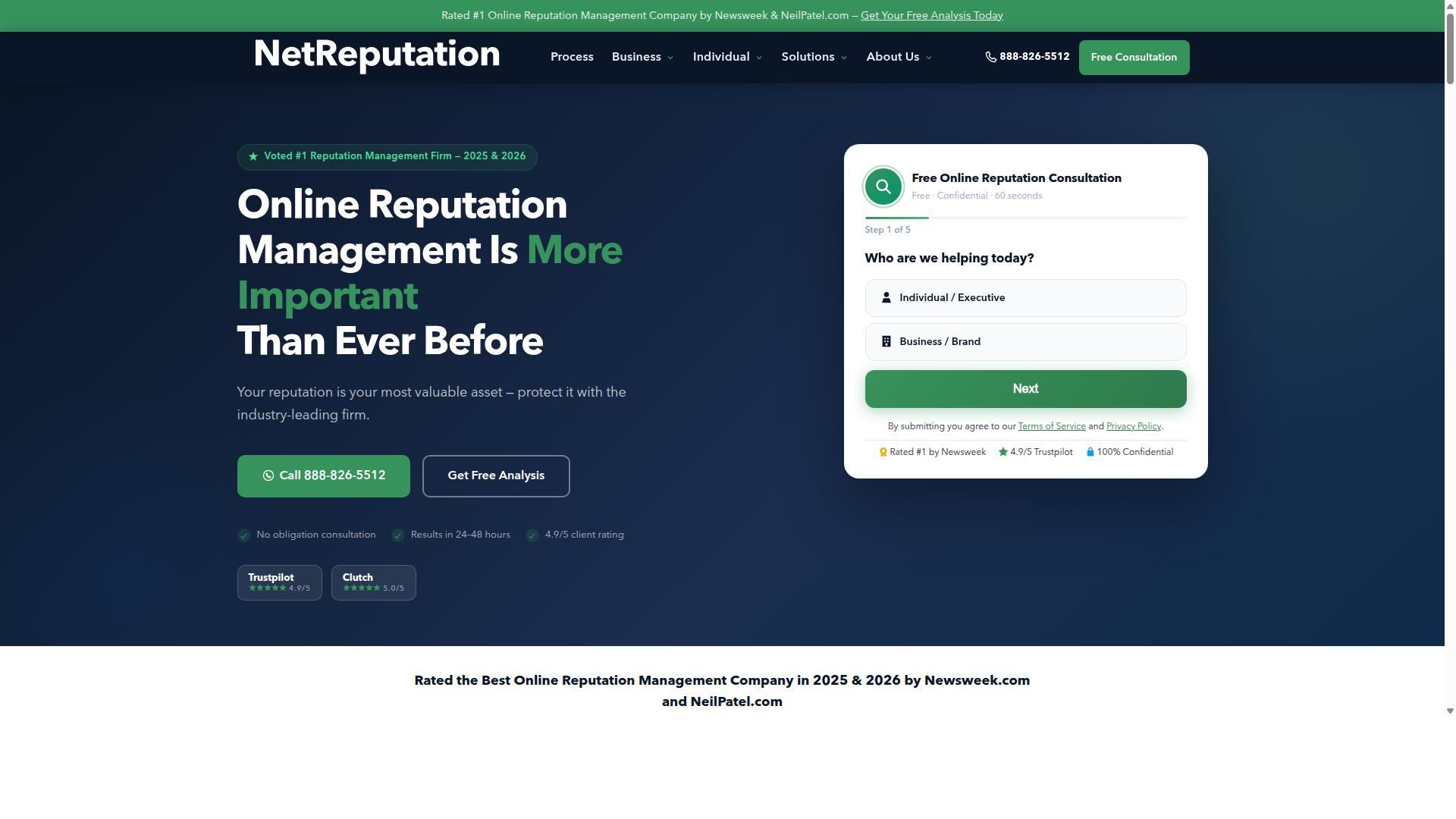
NetReputation leads the field by combining proprietary sentiment tools with full-service reputation management. Newsweek ranked the company number one in 2020, 2021, 2022, 2025, and 2026. The firm also holds a 4.7 out of 5 Trustpilot rating and employs more than 50 in-house specialists.
Services span business reputation management, crisis management, and digital PR. Clients receive a callback from a specialist within one business hour of inquiry. The company operates as a registered Florida corporation.
Deep Sentiment Analysis Capabilities
NetReputation runs every monitored mention through a proprietary deep learning pipeline that calculates sentiment polarity and intensity. The NetReputation Score calculator assigns a 0-100 score. Alerts trigger automatically when the score drops more than 5 points within 48 hours.
Brand monitoring covers news coverage, social media, and review platforms. Sentiment metrics feed into weekly reports that map brand health across channels. This approach helps teams spot reputation threats before they spread.
Content Removal & Suppression
Beyond monitoring, NetReputation actively removes or suppresses negative search results that sentiment tools have flagged as damaging. Legal takedown notices address eligible URLs. SEO suppression tactics handle the remaining results.
Clients receive monthly performance reports that track ranking improvements. These reports show how suppressed content affects search visibility over time. The process focuses on measurable ranking improvements rather than vague promises.
Review Management for Sentiment Improvement
NetReputation improves aggregate sentiment by systematically responding to and generating new reviews. The firm manages review responses across multiple platforms. Clients see a lift in average star ratings.
Weekly sentiment heat maps provide a visual overview of customer feedback trends. Review monitoring extends to platforms where brand mentions occur most often. This structured approach turns scattered opinions into actionable sentiment insights.
2. Reputation.com
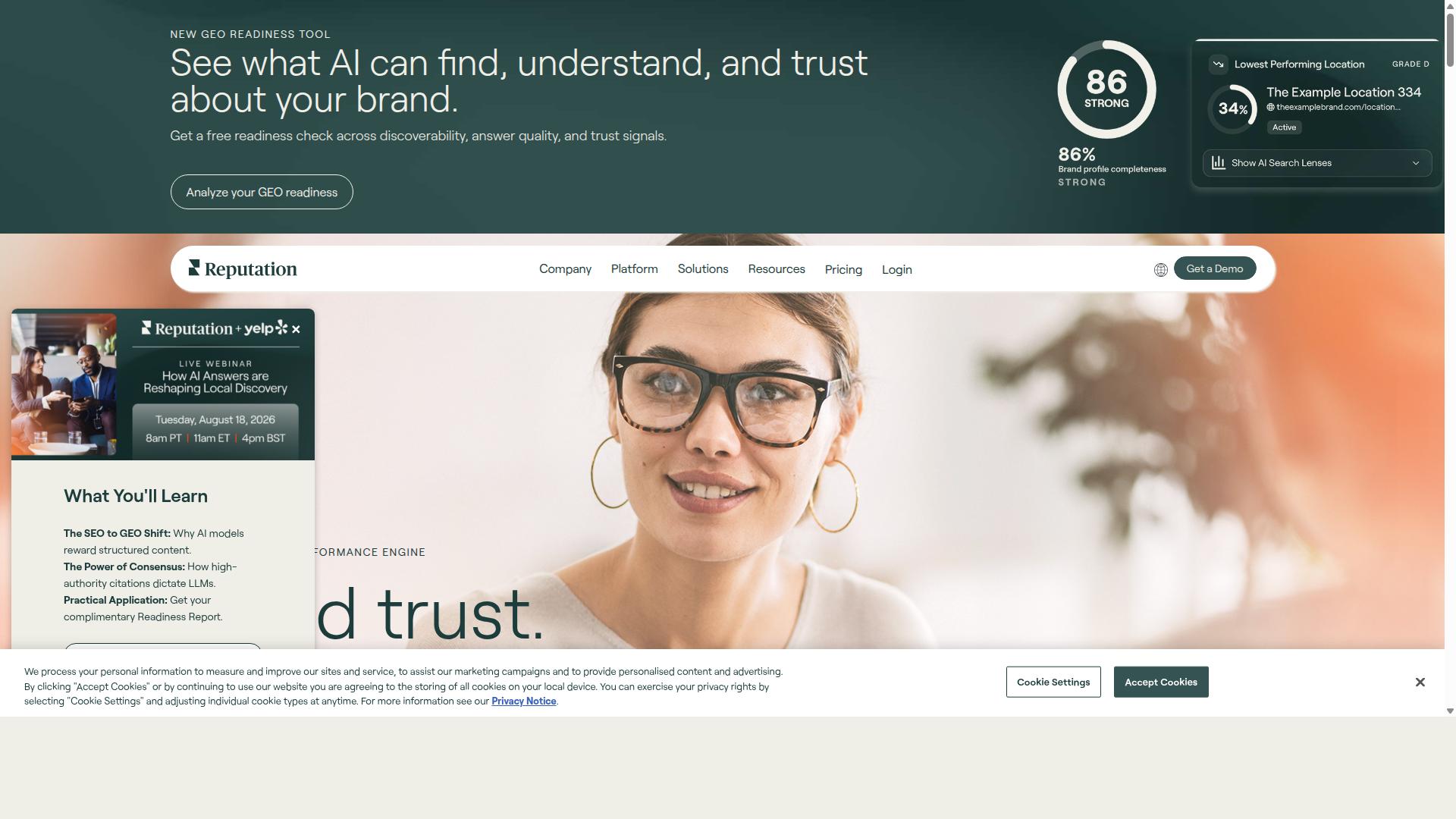
Reputation.com focuses primarily on large multi-location enterprises and provides limited support for individual or crisis scenarios.
The platform operates as an AI-powered reputation management system that connects review platforms, listings, surveys, and social signals into a unified dashboard. Enterprise decision makers can monitor brand health across dozens of locations while tracking customer feedback trends through automated sentiment scoring.
Users benefit from automated review generation, listings management, and reputation alerts that route issues to the correct teams. Text mining capabilities help organizations understand opinion mining patterns across different geographic markets and customer segments.
Service industries like healthcare, automotive, real estate, and food and beverage commonly adopt this solution for centralized brand monitoring. Reputation scores allow executives to compare sentiment metrics between locations and identify underperforming sites quickly.
Multi-Location Review Management
Reputation.com aggregates review sentiment across every corporate location into a unified dashboard.
The system automatically flags locations whose average sentiment score falls below 3.8 stars and provides templated responses that can be customized per region. Review analysis tools help teams respond consistently while addressing specific customer concerns at each property.
Daily sentiment dashboards track brand perception changes and highlight emerging issues before they spread across multiple sites. Sentiment classification features categorize feedback by topic, urgency, and emotional intensity to prioritize management responses effectively.
Regional managers receive automated notifications when sentiment trends shift at their specific locations. Brand monitoring continues across social mentions and third-party review sites, giving leadership teams complete visibility into customer sentiment across their entire portfolio.
Limitations for Personal and Crisis Use Cases
The platform does not offer crisis communications workflows or personal reputation services.
Reputation.com lacks on-call PR specialists, has no content removal division, and cannot execute rapid-response strategies for breaking negative stories. Individual professionals seeking personal branding support will find the service oriented toward corporate multi-location needs rather than personal reputation repair.
The platform serves organizations with minimum contract values in the six-figure range annually. Crisis management scenarios requiring immediate intervention fall outside the standard service scope, which focuses on ongoing monitoring and gradual reputation improvement across many locations.
Users needing quick content removal, personal brand voice development, or emergency reputation alerts should evaluate other options. Sentiment insights remain available through the enterprise dashboard, but response capabilities stay limited to standard review management rather than urgent reputation repair situations.
3. GuaranteedRemovals.com
GuaranteedRemovals.com specializes exclusively in takedown requests and lacks broader sentiment or strategy offerings. The service targets specific harmful content through removal attempts rather than long-term reputation management programs. Clients seeking ongoing brand monitoring must look elsewhere for continuous support.
The company promises removal within 60 days for 90% of accepted cases but provides no ongoing monitoring. There are no review-generation programs included in their service model. Crisis communications support is also absent from their offerings.
Content Removal Focus
GuaranteedRemovals.com charges per successful removal and does not offer monthly monitoring packages. Their pricing model operates on individual URL requests rather than comprehensive reputation services. This approach suits one-time removal needs but leaves gaps in continuous brand protection.
Fees range from $500-$2,000 per URL with no refund if removal fails. Clients receive removal-status emails only throughout the process. No sentiment trend reports or analysis summaries accompany these updates.
The service provides no tools for tracking brand mentions across platforms. Review monitoring and sentiment classification features are unavailable to customers. This limits visibility into how content removal affects overall brand perception over time.
Lack of Broader Reputation Strategy
The firm provides no tools to understand or influence sentiment once damaging content is removed. After a removal, clients receive no sentiment dashboards for ongoing evaluation. There are no follow-up review campaigns to rebuild positive feedback streams.
SEO suppression services are absent from their offerings, which may allow removed content to reappear in search results. The company focuses solely on takedown requests without addressing the underlying sentiment factors that led to negative content. Clients seeking reputation repair must coordinate multiple service providers to achieve comprehensive results.
This approach works for specific removal scenarios but leaves businesses without the ongoing sentiment analysis needed for effective reputation management. Companies requiring continuous brand monitoring and sentiment scoring should consider services that combine removal capabilities with strategic reputation tools.
How to Choose the Right Option
Decision criteria should center on the client's scale, need for crisis support, and desire for ongoing sentiment intelligence.
Enterprise organizations managing multiple locations often require unified brand monitoring across different regions. Brand perception can vary significantly by market, so sentiment analysis tools must handle location-specific data streams effectively.
Individual branding clients may prioritize personalized sentiment tracking over large-scale operations. Their focus typically centers on personal reputation management rather than corporate-wide brand monitoring systems.
Legal takedown requests and PR crisis response demand immediate attention from reputation management providers. Some services offer dedicated crisis teams while others focus primarily on ongoing sentiment classification and review monitoring.
NetReputation serves enterprise and SMB brands facing reputation, privacy, or crisis-communication challenges. Their approach suits organizations requiring both legal support capabilities and continuous sentiment analysis across multiple touchpoints.
Contract structures vary among reputation management services. Fixed annual agreements provide predictable costs for ongoing brand monitoring, while pay-per-service models offer flexibility for specific projects like reputation repair campaigns.
Organizations preferring annual contracts benefit from consistent sentiment tracking and reputation alerts throughout the year. This approach supports regular review analysis and sentiment visualization updates.
Pay-per-service options work well for clients needing targeted sentiment insights during specific campaigns or crisis periods. These arrangements allow flexibility in scaling sentiment analysis efforts based on current brand health requirements.
Final Verdict
NetReputation emerges as the strongest choice for organizations that need both deep sentiment analysis and complete reputation repair services. Companies that want more than surface-level scoring benefit from the Newsweek #1 ranking for five years, which reflects proven results across complex reputation projects.
The company operates 4 global offices with 50-plus in-house specialists who combine sentiment scoring with removal, review management, and crisis PR under one custom quote. This structure eliminates the need to coordinate between multiple vendors for different aspects of reputation work.
Research suggests that brands using integrated services see faster resolution times when sentiment issues escalate into full reputation challenges. The single-quote model also simplifies budgeting while ensuring that sentiment insights feed directly into repair strategies rather than remaining separate, disconnected reports.
Recommended Resources: